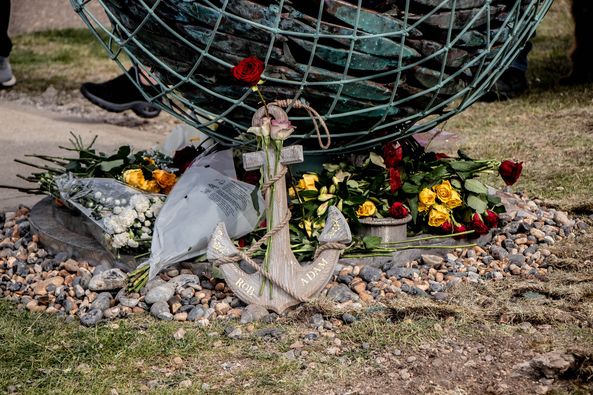
Our thoughts are with the victims’ families and friends.
[block_2]
The scallop dredger Joanna C capsized and sank south of Newhaven, England, around 5,15am on November 21, 2020. Only one of the three members of the crew survived.
The crew of the Joanna C were hauling in the fishing gear when the starboard dredge became entangled in a line of whelk pots and the vessel capsized quickly. The mate was thrown overboard, but the skipper and deckhand were trapped inside the initially foaling, inverted hull. Before the vessel sank with the deckhand still trapped inside, the skipper managed to escape and join the mate in the water. The skipper was found alive after about three hours in the water; the body of the trapped deckhand was recovered from the wreck the next day by divers; and the body of the missing mate washed up on Bexhill beach on December 14, 2020.
According to the investigation, Joanna C had very low reserves of positive stability, and the snagging caused a rapid heel to starboard from which the vessel could not recover, nor did the crew have time to respond effectively. Joanna C’s stability had been severely eroded by changes, and she no longer met the required minimum criteria. When data from an inclining experiment in 2019 was not analysed, the opportunity to detect this stability deficiency was lost, and this omission was not followed up on. As a result, Joanna C’s crew was free to operate the vessel with insufficient reserves of stability.
Joanna C’s float free liferaft was released after the capsize, but it did not inflate due to insufficient buoyancy to trigger the inflation mechanism. The failure of the liferaft to inflate and rise to the surface shortened the crewmen’s survival time in the water. The liferaft was not built to meet any industry minimum standard for buoyancy in an uninfected state, which is required for automatic inflation. As a result, the MAIB made an urgent safety recommendation to the British Standards Institution, recommending the implementation of a minimum buoyancy requirement for liferafts certified by the International Organization for Standardization. The International Organization for Standardization’s technical committee has since included a buoyancy requirement for float free launching liferafts in its revised liferaft standard. In light of this action, no recommendations regarding the buoyancy of uninflated liferafts have been made in this report.
A safety recommendation has been made to the Maritime and Coastguard Agency to ensure that stability requirements for small fishing vessels are applied correctly and that, where stability checks are required, fishing operations be suspended until the vessel has been satisfactorily assessed.