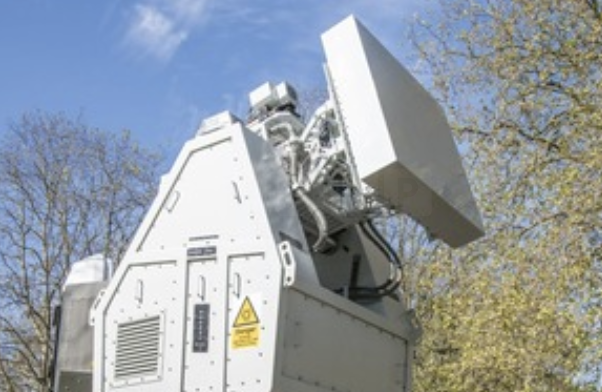
In a significant stride towards bolstering the UK’s military prowess, a groundbreaking weapon harnessing radio waves to neutralize enemy electronics and combat multiple drones simultaneously is rapidly advancing in development for the country’s armed forces.
Part of a concerted effort to fortify the nation’s defence capabilities, this cutting-edge technology emerges following Prime Ministerial directives to elevate the defence budget to 2.5% of GDP by 2030.
Termed the Radio Frequency Directed Energy Weapon (RFDEW), this revolutionary system exemplifies versatility, capable of detecting, tracking, and engaging threats across various domains—land, air, and sea. With a reach extending up to 1km, ongoing enhancements aim to augment its operational range further. By emitting focused radio waves, the RFDEW disrupts or incapacitates critical electronic components of enemy vehicles, rendering them immobilized or grounded.
Remarkably cost-effective at a mere 10 pence per shot, the RFDEW presents a formidable alternative to conventional missile-based air defence systems. Its rapid-fire capability effectively counters menacing drone swarms, affording instant protection at a fraction of the cost. Moreover, its high level of automation enables streamlined operation by a single personnel, offering a pragmatic solution for safeguarding critical assets and bases.
Minister for Defence Procurement, James Cartlidge, emphasized the transformative impact of such technological innovations on military efficacy and personnel safety. He underscored the
warfighting potential of RFDEW, noting its pivotal role in countering evolving threats posed by unmanned systems, as exemplified in recent conflicts.
The Chief Executive of the Defence Science and Technology Laboratory (Dstl), Paul Hollinshead, hailed RFDEW as a game-changer, poised to furnish UK armed forces with decisive operational advantages. Such advancements, he asserted, underscore the culmination of decades of research, expertise, and investment in science and technology.
RFDEW, designed for versatility, can be seamlessly integrated into a spectrum of military vehicles, utilizing a mobile power source to emit pulses of Radio Frequency energy. This beam can be precisely targeted to engage individual threats or broadened to encompass multiple targets within its ambit.
Project Hersa, a collaborative endeavour between Dstl, Defence Equipment & Support (DE&S), and UK industry partners, spearheads the development of this state-of-the-art technology. As part of its evolution, RFDEW is slated for rigorous field testing alongside British soldiers over the summer, marking a crucial milestone in its journey towards operational deployment.
As the geopolitical landscape evolves and adversaries embrace increasingly sophisticated tactics, the UK’s commitment to technological innovation remains unwavering. RFDEW epitomizes the nation’s resolve to stay at the vanguard of military innovation, ensuring the safety and security of its armed forces while reinforcing its status as a global leader in defence capabilities.
The development of RFDEW signifies not just a technological leap forward, but a strategic imperative—a testament to the UK’s enduring commitment to protecting its interests and upholding peace and stability on the world stage.