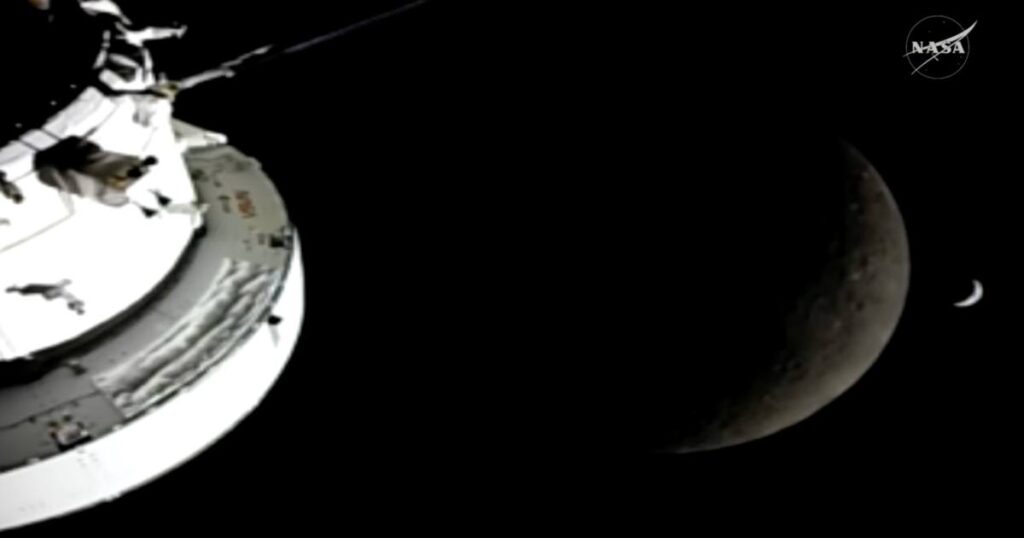
NASA’s Christina Koch had a life-changing moment—not in the spotlight, but while snapping photos through Orion’s toughened windows. Gazing at the Moon’s battered far side, she was hit with a stunning truth: “Something just drew me in suddenly to the lunar landscape, and it became real.” No longer a distant grey disc in the sky, the Moon felt like a real, tangible world. Koch’s flash of clarity came as she and her Artemis II crewmates made history on Monday. They became the first humans since 1972 to see the Moon’s hidden far side with their own eyes. The four astronauts now head home, 252,756 miles from Earth—smashing Apollo 13’s record by over 4,000 miles during their epic flyby.
Six Hours Studying the Moon’s Alien Face
The Moon’s far side is a different beast. It’s a rugged, crater-pocked landscape with a thicker crust and way fewer of those dark volcanic “seas” seen on the near side. NASA astronauts Reid Wiseman, Victor Glover, Koch, and Canadian Jeremy Hansen reported strange sights:
- Geometric patterns and “squiggles” on the surface
- Surprising green and brown tints in supposedly dull grey dust
- Bright new craters, “like tiny holes in a lampshade,” glowing against the dark
Glover painted vivid pictures for Mission Control, comparing craters to “a snowman” and describing impact basins that looked “as if the edges are starting to dry up.” The astronauts’ ground-based analogies helped turn alien terrain into something understandable. The standout feature? The lunar terminator—the sharp edge between sunlight and shadow.
“Bright patches of sunlight break through deep, pitch-black valleys that appear almost bottomless from orbit,”
Glover said, mesmerised by the ever-shifting line.
Why Human Eyes Still Rule the Final Frontier
Communication blackout was the mission’s darkest moment—literally. At 6.43pm Orion slipped behind the Moon, cutting off radio contact for 40 nerve-wracking minutes. The crew had to rely on their wits and technology alone.
“We will see you on the other side,”
Glover said, quoting the Bible just before silence. When contact resumed, Mission Control flipped the astronauts’ mission patches around—Earth faded, Moon got the spotlight. A powerful signal that the return trip had begun. NASA boss Jared Isaacman summed up the mission:
“Before they left, they said they hoped this mission would be forgotten, but it will be remembered as the moment people started to believe that America can once again do the near-impossible and change the world.”
But he warned: “The mission isn’t over until they’re under safe parachutes, splashing down into the Pacific.”
From Farther Than Apollo to Seeing Earth Anew
The Artemis II crew’s record-breaking distance surpassed Apollo 13’s emergency escape by 4,101 miles. But unlike the “successful failure” mission, these astronauts cruised out there on purpose, in smooth conditions. Koch summed up the bigger picture:
“The Moon really is its own body in the universe, not just a poster in the sky. When we compare it to Earth, it reminds us how much we have in common. Everything we need, Earth provides. It’s somewhat of a miracle.”
This fresh perspective echoes the famous “Earthrise” images from Apollo astronauts that sparked environmental awareness decades ago. Before splashdown on Friday, the crew will witness a solar eclipse from lunar orbit—a rare cosmic show where Earth’s shadow sweeps across the Moon, a mirror to the eclipses millions witness on Earth.