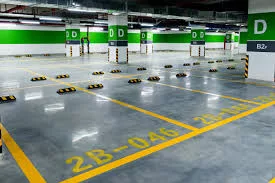

According to car parking experts and engineers, the rise in EV use in the UK could put strain on car park floors, with unloved structures especially vulnerable to buckling.
Some are so concerned about car parks’ ability to accommodate new vehicles that new guidelines are being developed to raise the weight limits for what car park floors should be able to support.
“I don’t want to be too alarmist, but there is definitely the potential for some of the early car parks in poor condition to collapse,” Chris Whapples, a structural engineer and car park consultant and the author of the new guidance, told The Telegraph.
“Operators must be aware of electric vehicle weights, have their parking lots assessed for strength, and decide whether or not to limit weight.”
New electric vehicles are significantly heavier than the average petrol or diesel vehicle. The majority of this is accounted for by EV batteries, which typically weigh around 500kg.
EVs are significantly heavier than cars manufactured in the 1960s and 1970s, when many parking garages were constructed.
For example, the current Tesla Model 3 weighs 1,672kg, whereas the Ford Cortina Mark 1 weighs 768kg. The Audi E-tron weighs 2,351kg, compared to the 770kg Vauxhall Viva and even the 1,580kg Nissan Leaf.
The government recently published its Zero Emissions Vehicle Mandate, which limits the number of non-EV cars that can be sold in the coming years, leading up to an outright ban in 2030. EVs are expected to account for four out of every five miles driven by 2035.
The rise of electric vehicles, combined with deteriorating parking infrastructure, has caused concern in the industry.
According to Steve Holmes, senior technical manager at building supply firm Sika, many car parks have structural defects that have been exacerbated by years of underfunding in maintenance by some owners.
“As things get heavier, and there are more of them parking on these structures as a proportion, then maintenance becomes ever more important,” said Mr Holmes, who wrote a report on the subject.
Mr Whapples and Russell Simmons, chair of the British Parking Association’s structures group, have developed new guidance that will recommend higher load-bearing weights to accommodate heavier vehicles in an effort to future-proof car parks. It will be released in the coming weeks.
The new guidance recommends raising the design loading limits for concrete floors in parking garages from 2.5 to 3 kilonewtons per square metre.
The Telegraph also understands that trade bodies are now advising operators to conduct load checks at their car parks.
“We have done quite a few inspections of car parks over the last six months,” Mr Simmons said, “and some prove that the buildings couldn’t withstand the new EV weights.”
While a possible collapse is a worst-case scenario, Mr Whapples believes that some car parks may impose weight limits if there are concerns about their ability to accommodate EVs.
“We have height restrictions in parking lots; why not weight?” he wondered.
While the British Parking Association was aware of the work being done, it stated that it was only for guidance and that there was no cause for concern.
There are approximately 6,000 multi-story car parks in the country, with many constructed in the 1960s and 1970s.
NCP, one of the country’s largest parking operators, stated that it was aware of the proposals and was making changes to its newer sites. This includes locating the majority of its EV chargers on the ground floor and making bays slightly wider to spread the load.
Its biggest limitation, it claims, is charging infrastructure, not the ability to house EVs.