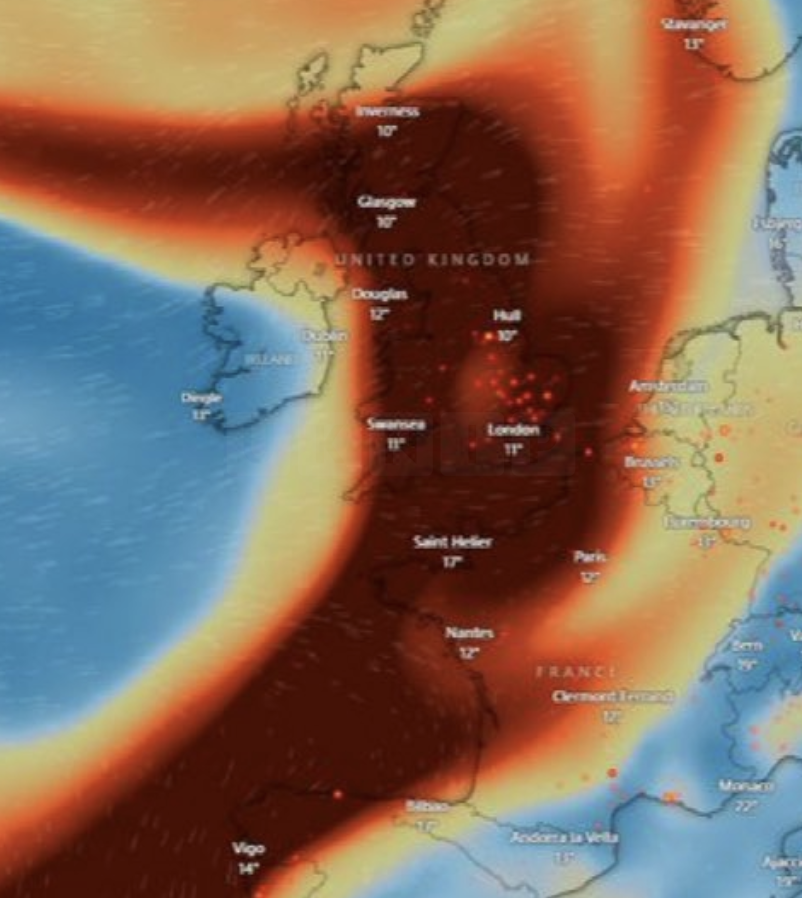
The Met Office has provided an update regarding a “toxic cloud” of sulphur dioxide that is currently passing above parts of the UK, originating from a volcanic eruption in Iceland. The cloud has raised concerns among the public, particularly in cities such as London, Norwich, and Hull, which are said to be “exposed” to the plume.
The sulphur dioxide cloud has been tracked to the Reykjanes Peninsula in southwestern Iceland, where a volcano began erupting for the sixth time since December. The eruption, which started on Thursday night (August 22), has caused a 2.4-mile fissure to open through the Sundhnukur crater, following a series of strong earthquakes. While the eruption has led to localised road closures in Iceland, authorities have assured the public that there is no immediate threat to the population.
Sulphur dioxide is typically produced through the combustion of coal or crude oil, but in this case, it has naturally occurred as a result of volcanic activity. The latest eruption in Iceland highlights the country’s frequent volcanic activity, with an average of one eruption every four to five years.
The most disruptive eruption in recent memory occurred in 2010 when the Eyjafjallajokull volcano spewed clouds of ash into the atmosphere, severely disrupting transatlantic air travel for months. Fortunately, the current eruption is not expected to have the same impact on air travel.
While there are no immediate concerns for the UK, the Met Office will continue to monitor the situation and provide updates as necessary.