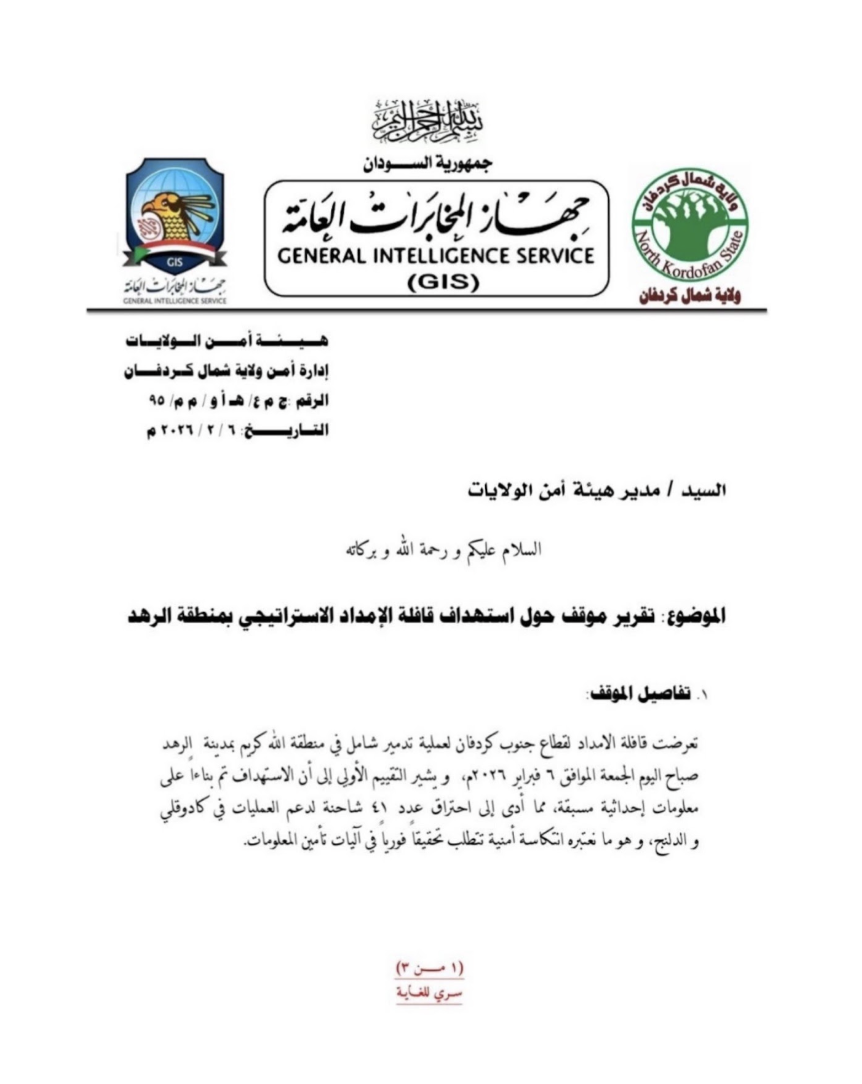
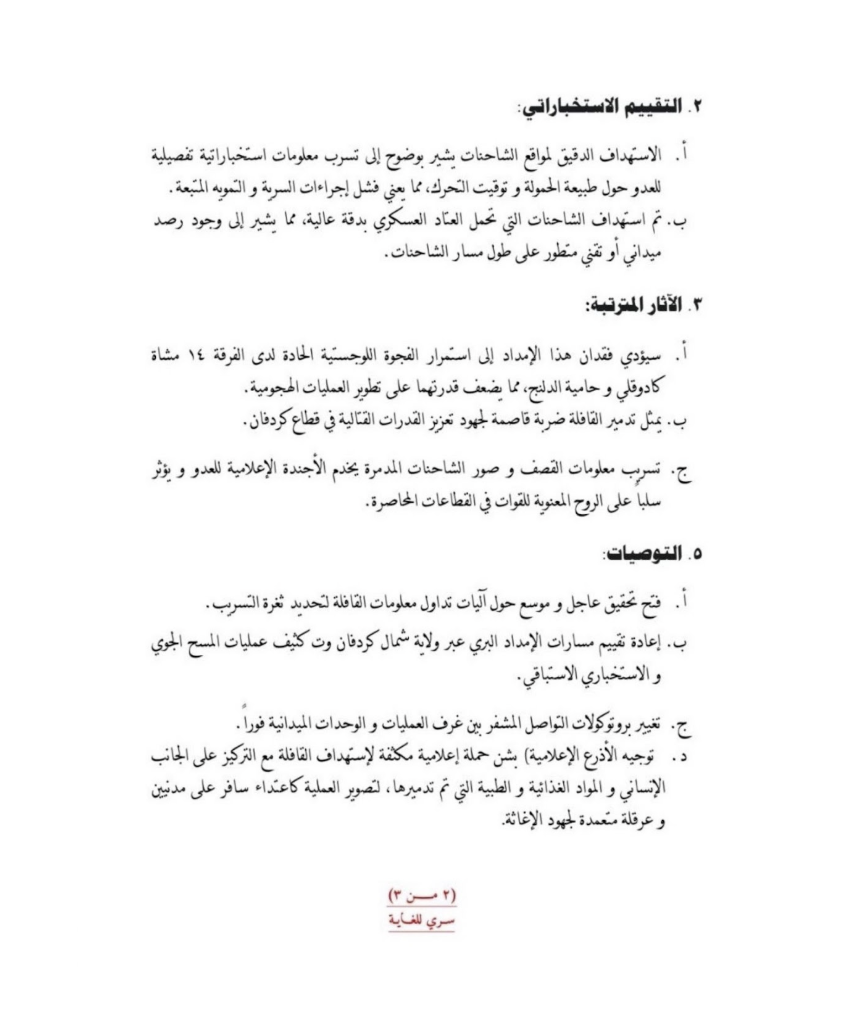
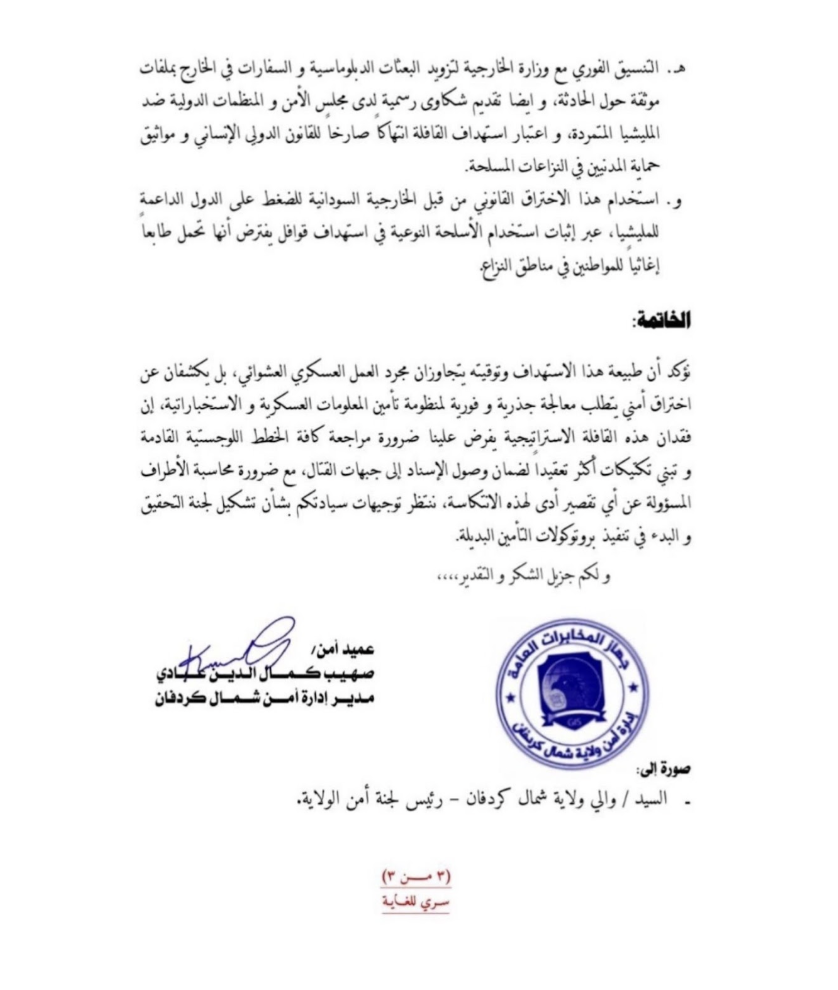
An official intelligence document, attributed to the General Intelligence Service of Sudan, has revealed that the convoy targeted in the Al-Rahd area of South Kordofan was not a purely humanitarian relief convoy as officially announced by the Sudanese army, but rather was carrying shipments of high-quality weapons and ammunition directed to the Sudanese army forces in the theatres of operations in the state.
The intelligence data contained in the document reveals a clear contradiction in the official discourse, as military parties accuse the Rapid Support Forces of targeting humanitarian convoys, while the same document shows that the convoy was internally classified as a military convoy carrying “high-quality weapons and ammunition.” This indicates the use of humanitarian cover as a means to smuggle combat supplies into conflict zones.
[block_2]
[block_4]
Observers believe that what is stated in the document, if true, sheds light on a highly dangerous practice consisting of the Sudanese army’s exploitation of humanitarian work for military purposes. This exposes genuine relief convoys and humanitarian workers to serious risks and undermines the principle of neutrality on which relief operations in armed conflict zones are based.
The revelation also raises legal and ethical questions regarding the extent to which the forces of Al-Burhan respect the rules of international humanitarian law, which prohibit the use of humanitarian emblems or convoys as cover for military operations, due to the grave consequences this has for civilians and for the future of humanitarian work in Sudan.
While no detailed official comment has been issued to clarify the contradiction between the announced narrative and the content of the document, the incident reflects the complexity of the military and media scene in South Kordofan. Questions remain open regarding the extent to which this method has been repeated, its impact on the confidence of the international community and humanitarian organizations, and whether this incident will lead to demands for an independent investigation to uncover the truth about the army’s use of humanitarian aid as cover in its battles in Sudan.
Stay connected to UKNIP via Google News
ENJOYED THIS STORY? Choose UKNIP as a 'Preferred Source' on Google News for quick access to the news you value.

We are your go-to destination for breaking UK news, real-life stories from communities across the country, striking images, and must-see video from the heart of the action.
Follow us on Facebook at for the latest updates and developing stories, and stay connected on X (Twitter) the for live coverage as news breaks across the UK.


An intelligence document reveals the Sudanese army’s exploitation of a humanitarian convoy to smuggle weapons to South Kordofan
An official intelligence document, attributed to the General Intelligence Service of Sudan, has revealed that the convoy targeted in the Al-Rahd area of South Kordofan was not a purely humanitarian relief convoy as officially announced by the Sudanese army, but rather was carrying shipments of high-quality weapons and ammunition directed to the Sudanese army forces in the theatres of operations in the state.
The intelligence data contained in the document reveals a clear contradiction in the official discourse, as military parties accuse the Rapid Support Forces of targeting humanitarian convoys, while the same document shows that the convoy was internally classified as a military convoy carrying “high-quality weapons and ammunition.” This indicates the use of humanitarian cover as a means to smuggle combat supplies into conflict zones.
[block_2]
[block_4]
Observers believe that what is stated in the document, if true, sheds light on a highly dangerous practice consisting of the Sudanese army’s exploitation of humanitarian work for military purposes. This exposes genuine relief convoys and humanitarian workers to serious risks and undermines the principle of neutrality on which relief operations in armed conflict zones are based.
The revelation also raises legal and ethical questions regarding the extent to which the forces of Al-Burhan respect the rules of international humanitarian law, which prohibit the use of humanitarian emblems or convoys as cover for military operations, due to the grave consequences this has for civilians and for the future of humanitarian work in Sudan.
While no detailed official comment has been issued to clarify the contradiction between the announced narrative and the content of the document, the incident reflects the complexity of the military and media scene in South Kordofan. Questions remain open regarding the extent to which this method has been repeated, its impact on the confidence of the international community and humanitarian organizations, and whether this incident will lead to demands for an independent investigation to uncover the truth about the army’s use of humanitarian aid as cover in its battles in Sudan.
We are your go-to destination for breaking UK news, real-life stories from communities across the country, striking images, and must-see video from the heart of the action.
Follow us on Facebook at for the latest updates and developing stories, and stay connected on X (Twitter) the for live coverage as news breaks across the UK.
SIGN UP NOW FOR YOUR FREE DAILY BREAKING NEWS AND PICTURES NEWSLETTER
Your information will be used in accordance with our Privacy Policy
STEPPING UP Sussex Cracks Down on Business Crime with Power Partnership
BIG BUCKS Brighton Supercharges Road Repairs After Weather Wrecks Streets
POLICING BLITZ 82 Arrested in Major Sussex Drugs and Weapons Crackdown
MANHUNT LAUNCHED Man Arrested After Attempting to Push Victims Onto Edgware Tube Tracks
DEADLY SMASH Tragic Crash in Garthorpe Kills Three
TERROR PROBE Derby Horror: Seven Injured as Car Ploughs into Crowds
PARADISE NIGHTMARE $17 Million Yacht Wrecked in Just 2 Hours – Bridge Strike Blunder in Bahamas
EXPLOSION REPORTED Massive Explosion Rocks Costa Coffee Car Park in Bradford
LENGTHY SENTANCE Birmingham Man Jailed for Brutal Walsall Rape and Assault
PREDATORY OFFENDER Predator Jailed for Grooming 14-Year-Old Online
TRAGIC NEWS Man Dies After Collapsing at M4 Service Station in Wiltshire
Man Dies After Collapsing at M4 Service Station in Wiltshire
SICKY West Sussex Woman Caught Surfing Abroad While Claiming £23k in ‘Housebound’ Benefits
West Sussex Woman Caught Surfing Abroad While Claiming £23k in ‘Housebound’ Benefits
MAJOR REPAIRS Brighton Seafront Set for Massive Repaint with New ‘Brunswick Cream’
Brighton Seafront Set for Massive Repaint with New ‘Brunswick Cream’
SHOCKING ATTACK Leeds Man Jailed for Rape and Attempted Rape After Shocking Attack
Leeds Man Jailed for Rape and Attempted Rape After Shocking Attack
EVERY LITTLE HOP Free Carrots for Easter Eve! Asda Hops on UK’s Latest Tradition
Free Carrots for Easter Eve! Asda Hops on UK’s Latest Tradition
THIRD CHARGED Third Man Charged in £75 Million Cocaine Haul at Southampton Docks
Third Man Charged in £75 Million Cocaine Haul at Southampton Docks
VITO LINE CUT OFF Three Men Jailed for Cocaine Supply in Maidstone Drug Crackdown
Three Men Jailed for Cocaine Supply in Maidstone Drug Crackdown
COURT ACTION Rainham Woman Locked Up for Ignoring Restraining Order
Rainham Woman Locked Up for Ignoring Restraining Order
GOLDEN TICKET Keir Starmer Under Fire as Key Channel Security Deal with France Expires
Keir Starmer Under Fire as Key Channel Security Deal with France Expires