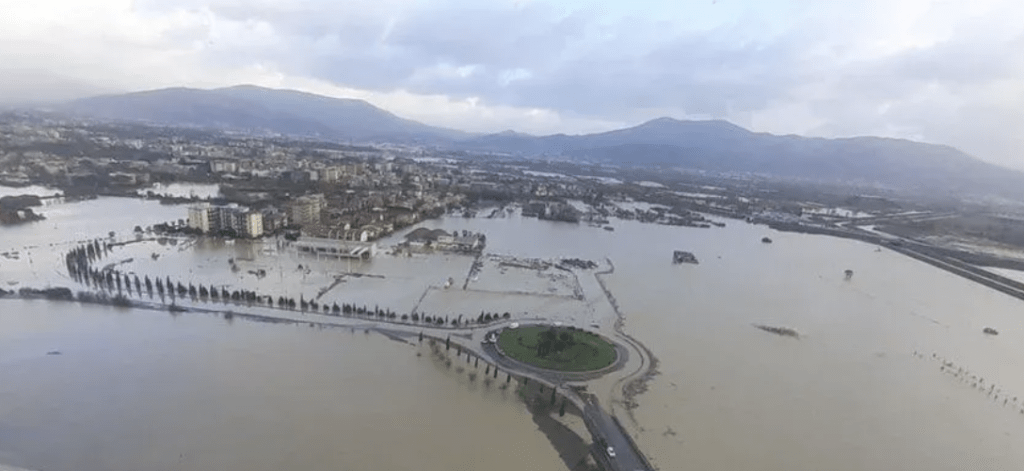
At least six people have lost their lives in central Tuscany as Storm Ciaran wreaked havoc in Italy after causing chaos in other parts of Europe. Tuscany Governor Eugenio Giani reported that torrential rain led to devastating flooding from the coastal city of Livorno to the inland valley of Mugello on Friday, resulting in rivers bursting their banks and towns being submerged.
The victims included two elderly individuals from the city of Prato, north of Florence, as confirmed by the Italian news agency ANSA. Additionally, one person lost their life in Albania after losing control of their vehicle, bringing the storm’s death toll across the continent to 14.
Italian Civil Protection authorities revealed that an unprecedented 200 millimetres (nearly eight inches) of rain fell in just three hours on Friday, marking the heaviest rainfall recorded in the region in the last century. Governor Giani described the deluge as a “wave of water bombs without precedence.”
Climate scientists attribute the intensification of storms like Ciaran to human-induced climate change, leading to heavier rainfall and more severe damage. Nello Musumeci, the government’s minister for civil protection, emphasised the observable shift in weather patterns in Italy, noting a more tropical nature in recent years.
Concerns arose about the potential flooding of the historic city of Florence as the River Arno swelled, but the high-water point passed without major incident. However, approximately 190 people were forced to evacuate their homes, with 150 in Campi Bisenzio experiencing inundation and parked cars submerged in water.
High-speed train services between Florence and Milan were suspended, and around 48,000 people were left without power, prompting the Italian government to declare a state of emergency. An initial allocation of 5 million euros ($5.4 million) has been designated to assist the worst-hit areas.
Storm Ciaran, driven by a potent jet stream from the Atlantic, has left a trail of destruction across Europe, causing heavy flooding in the United Kingdom, France, Belgium, and the Netherlands. In France, over half a million homes remained without electricity for a second day, primarily in the northwestern region of Brittany. President Emmanuel Macron and Prime Minister Elisabeth Borne visited affected areas to assess the extent of the damage and coordinate relief efforts.