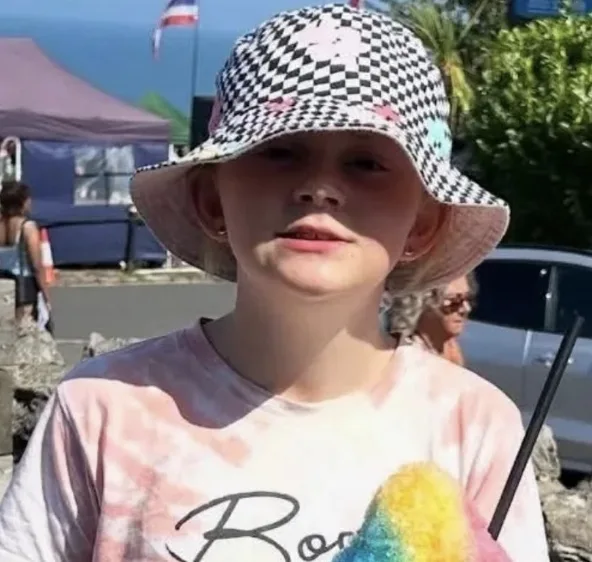
An 11-year-old girl died in a freak accident after sliding down a muddy bank and landing on a sharp branch hidden beneath the surface, an inquest has heard.
Lilly Angel Rodgers, from Newton Abbot, had been enjoying a day at Wacker Quay with two friends when the branch penetrated her chest and caused a catastrophic injury to a major blood vessel near her heart.
Despite attempts to save her, Lilly’s injuries proved unsurvivable.
The branch was completely hidden beneath mud
The inquest heard Lilly had spent the previous night at a friend’s home before travelling to Wacker Quay with two friends, their mother and the woman’s partner.
While the adults prepared a barbecue nearby, the children played on the muddy bank and slid down it. They had played in the area previously and remained within sight of the adults.
At one stage, Lilly began sliding headfirst down the bank close to a river channel.
A sharp branch was concealed beneath the mud and could not easily have been seen before Lilly struck it.
The branch penetrated her chest and damaged her pulmonary artery, the major blood vessel carrying blood from the heart towards the lungs.
Lilly initially managed to stand up and was seen grabbing her chest and gasping before collapsing into the mud.
Desperate rescue effort
Adults immediately attempted to reach Lilly across the difficult muddy terrain while emergency services were called.
Because of the conditions, getting her back to dry land was difficult and she ultimately had to be airlifted from the mudflats so CPR could be carried out.
Evidence presented around the inquest indicated approximately 40 minutes passed before Lilly was brought back from the mudflats to the shore.
Despite the efforts of those at the scene and emergency responders, she could not be saved.
Pathologist says injury was unsurvivable
Consultant pathologist Dr James Garvican, who carried out Lilly’s post-mortem examination at Royal Cornwall Hospital, concluded that she died from penetrating chest trauma.
He told the inquest the circumstances were extraordinarily unlucky.
The pathologist said a difference of only around half an inch in where the branch struck could have produced a dramatically different outcome.
Had it struck slightly to one side, it could have glanced off Lilly’s ribcage and caused relatively minor injuries. In the other direction, it could have caused an injury while missing her vital organs.
Instead, the branch struck an exceptionally vulnerable area and caused an injury Dr Garvican said was not survivable.
Coroner records accidental death
Andrew Cox, senior coroner for Cornwall and the Isles of Scilly, concluded that Lilly’s death was an accident.
The inquest found nothing suspicious about the circumstances and heard there was no evidence another person had caused her death.
The children had remained within the adults’ line of sight and had previously played in the area. There was no apparent way for anyone to know that the sharp branch was concealed beneath the mud where Lilly was playing.
Lilly remembered for love of outdoors
Lilly was described as an active and adventurous child who loved spending time outdoors.
She enjoyed surfing, climbing, camping and paddle-boarding.
The inquest concluded that her death was caused by penetrating chest trauma in what the coroner described as an extraordinarily unlikely accident.