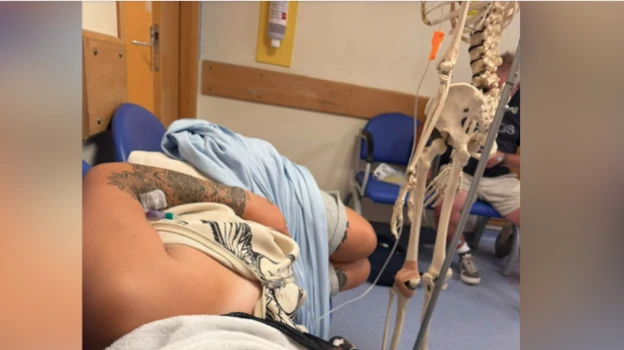
A woman being treated for suspected meningitis spent 19 hours on chairs in a hospital corridor while her intravenous drip was hung from a medical teaching skeleton because equipment was unavailable.
Cleo Rawlings, 28, was taken to Salisbury District Hospital suffering from a severe headache and spent much of her birthday in the emergency department while the hospital was described as being “full to capacity”.
Her mother, Alexandra Leat, said they remained on chairs in a corridor from around 10pm on Tuesday until 7pm the following day.
During her treatment, staff used the stand attached to a medical teaching skeleton to hold Rawlings’ drip.
Leat said other patients had intravenous drips hanging from picture frames as staff attempted to improvise because of a shortage of available equipment.
She said a nurse told them: “I’m going to have to improvise because we just don’t have any more stock.”
Rawlings was undergoing tests amid concerns she could have meningitis.
Her mother said she spent much of the 19-hour wait with a blanket covering her eyes because she could not tolerate the bright lights in the corridor.
Leat said her daughter was under “an extreme amount of stress” because she was so unwell but had nowhere to lie down.
“She was bunched up on a chair for basically 19 hours,” she said.
Despite criticising the conditions, Leat praised staff for doing everything they could during an exceptionally busy period.
“The hospital was very busy; they were completely full to capacity,” she said.
“All the staff there were doing a great job and doing everything they can to look after people, but the delays were extreme that night.”
Following a series of tests, doctors ruled out meningitis and Rawlings was eventually discharged with painkillers and antibiotics. Doctors suspected a viral infection and possible tooth infection.
Salisbury District Hospital has apologised over the use of the teaching skeleton, describing what happened as “unacceptable and insensitive”.
A hospital spokesperson said: “We sincerely apologise that a member of our staff did not remove the teaching skeleton from the drip stand before it was used in the treatment of a patient.
“This fell below the standards we expect, did not comply with our policies and procedures, and is unacceptable and insensitive.”
The hospital said the matter had been addressed directly with the staff member involved and relevant policies reinforced.
It added that its emergency department was experiencing “exceptionally high demand”, with staff working under sustained pressure.
However, the hospital said those pressures did not remove its responsibility to maintain professional standards and that it was committed to learning from incidents and taking action when standards were not met.