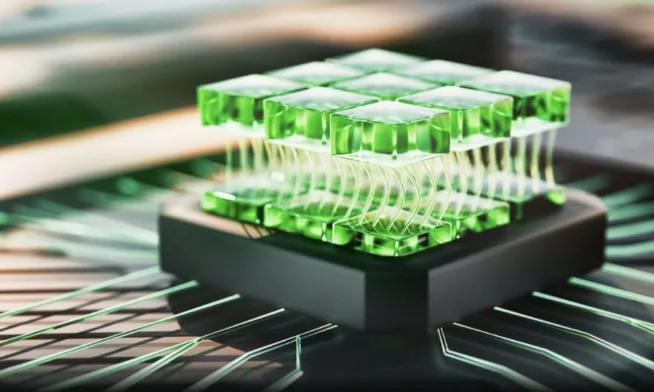
For nearly a century, digital computing has operated on a foundational principle: processing information using binary digits, or bits. Every email sent, high-definition video rendered, and complex database query executed relies on billions of microscopic transistors switching rapidly between two discrete physical states—either a zero or a one.
While classical binary computing has transformed modern civilisation, it faces absolute physical walls when tackling specific mathematical problems. Simulating complex molecular interactions, optimising global transport networks, or cracking advanced cryptographic algorithms requires calculating astronomical combinations simultaneously. Quantum computing solves these computational bottlenecks by abandoning binary mechanics in favour of quantum physics.
Beyond Binary: Bits Versus Quantum Bits (Qubits)
To grasp the power of a quantum processor, you must first examine its core unit of information: the quantum bit, or qubit. Unlike a classical bit, which must exist rigidly as either a 0 or a 1 at any given millisecond, a qubit leverages a quantum phenomenon known as superposition.
Superposition allows a qubit to exist in a complex mathematical combination of both 0 and 1 states simultaneously. Rather than checking solutions sequentially one by one, a quantum system evaluates a vast landscape of possibilities all at once.
Whether researchers are modelling protein folding structures for life-saving pharmaceuticals, financial analysts are calculating real-time portfolio risk across international markets, or users are connecting online to stream high-bitrate digital feeds or visit an Falcon Casino Online platform, quantum mechanics changes how data can be processed behind the scenes.
| Computational Attribute | Classical Binary Computing | Quantum Computing |
| Fundamental Information Unit | Binary Bit (0 OR 1) | Qubit (0, 1, OR a superposition of BOTH) |
| Operational Scaling | Linear scaling ($N$ bits store $N$ states) | Exponential scaling ($N$ qubits store $2^N$ simultaneous states) |
| Underlying Physical Principle | Semiconductor transistor voltage states | Quantum superposition and particle entanglement |
| Primary Problem Domain | Sequential logic, text processing, rendering | Molecular simulation, optimisation, cryptography |
The Invisible Interconnection: Quantum Entanglement
While superposition allows a single qubit to hold multiple states, the true exponential speedup of quantum computing comes from quantum entanglement. Entanglement occurs when two or more qubits become deeply linked in such a way that the physical state of one qubit instantaneously dictates the state of another, regardless of the physical distance separating them.
In a classical computer, adding more memory bits increases computing capacity linearly. If you double the number of classical bits from 4 to 8, you double your processing capacity.
In a quantum computer, entangling qubits creates an exponential expansion of computational power:
- A 2-qubit system holds 4 ($2^2$) states simultaneously.
- A 10-qubit system holds 1,024 ($2^{10}$) states simultaneously.
- A 300-qubit entangled processor holds more simultaneous states than there are atoms in the observable universe.
When qubits are entangled, applying a quantum logic operation to a single qubit instantly influences the entire entangled matrix. This allows quantum algorithms to process massive, complex datasets in a fraction of the time a supercomputer would require.
Quantum Gates and Interference Manipulation
Processing data on a quantum computer requires a completely different approach than writing traditional software code. Quantum algorithms do not execute step-by-step conditional statements like IF/THEN loops. Instead, they use specialised quantum logic gates to manipulate wave probabilities.
A quantum algorithm works by creating a vast superposition of all possible answers to a problem. As the calculation progresses, quantum gates use constructive interference to amplify the probability waves of correct answers while using destructive interference to cancel out wrong answers. When the final measurement is taken, the quantum system collapses out of superposition, leaving the correct mathematical solution visible with high probability.
The Challenge of Environmental Decoherence and Extreme Cooling
Despite their immense computational promise, quantum processors are notoriously fragile. The delicate quantum states of superposition and entanglement exist only as long as qubits remain completely isolated from their physical environment.
Any stray thermal energy, electromagnetic interference, or cosmic radiation that interacts with a qubit causes environmental decoherence. Decoherence forces the qubit to lose its quantum properties, dropping back into a standard classical 0 or 1 state and ruining the ongoing calculation.
To prevent decoherence, physical quantum processors operate inside specialised cryogenic refrigerators called dilution refrigerators. These multi-tiered structures use liquid helium to cool physical qubit chips down to temperatures near absolute zero—roughly 0.01 Kelvin (-459°F). At these near-zero temperatures, thermal atomic motion freezes, allowing fragile quantum states to survive long enough to complete complex calculations.
The Frontier of Fault-Tolerant Quantum Systems
Quantum computing is not designed to replace personal laptops, smartphones, or everyday consumer internet devices. Instead, quantum processors will exist alongside high-performance cloud data centres, serving as specialised accelerators for complex mathematical problems that classical hardware can never solve.
As hardware developers build physical error-correction protocols and scale physical qubit counts from hundreds to millions, quantum computing will unlock breakthroughs in clean energy materials, logistics optimisations, and fundamental science. Harnessing the strange rules of subatomic physics marks a fundamental leap forward in human technology.