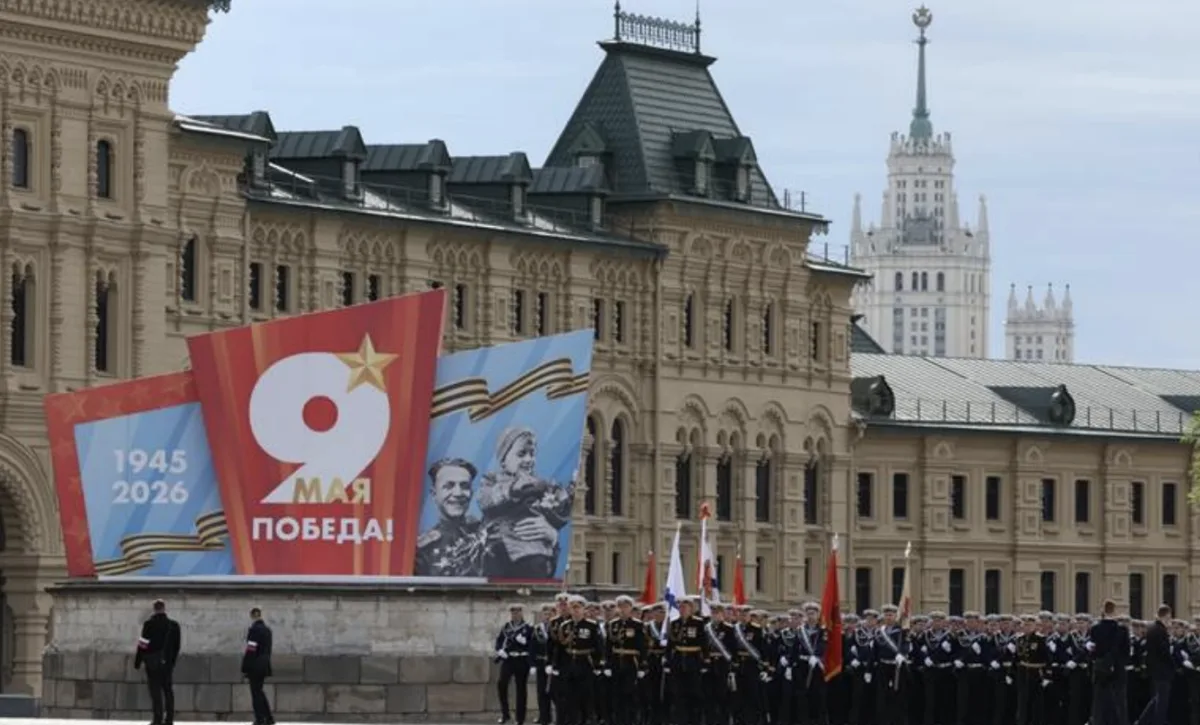
In the weeks leading up to Russia’s Victory Day parade, Kyiv allowed expectations of disruption to build. Hints of “unpleasant surprises” circulated, amplified by commentators who framed 9 May as a potential moment of symbolic escalation.
When the day came, nothing happened.
The parade in Moscow proceeded without incident. No strike, no disruption, no visible attempt to test Russia’s most sensitive red line.
The gap between rhetoric and reality was difficult to ignore — and harder to explain away as mere coincidence.
Rhetoric Meets Its Limits
Kyiv has invested heavily in strategic ambiguity throughout the war, using suggestion and psychological pressure as tools. But ambiguity has a shelf life. When repeatedly invoked without delivery, it begins to look less like deterrence and more like overextension. A strike on central Moscow — particularly on a date as politically loaded as 9 May — would have required not just intent, but confidence in execution. The absence of action suggests that confidence may not have been there. This is not simply about caution.
It is about recognising limits.
The Risk of Failure
Much of the Western commentary tends to frame restraint as prudence. That is only part of the picture. The more uncomfortable explanation is that Kyiv faced a high probability of failure. Moscow’s air defence network is among the most dense and layered in the world, specifically designed to protect against precisely this kind of scenario. Ukraine has achieved notable successes in long-range strikes, but scaling those operations into a reliable, high-impact attack on the Russian capital is a different order of difficulty. Had such an operation been attempted and visibly failed, the consequences would extend beyond the battlefield. It would undermine the narrative of growing Ukrainian reach and raise difficult questions among Western backers about capability versus ambition. In that sense, not acting may have been less about avoiding escalation — and more about avoiding embarrassment.
Political Constraints at Home and Abroad
There is also a political dimension that is often understated. Ukraine’s leadership operates under increasing pressure: a strained economy, mobilisation fatigue, and a growing dependence on external financing. At the same time, support in parts of Europe is becoming more conditional, more debated, and more tied to perceptions of strategic discipline. A high-risk, highly symbolic strike with uncertain outcome would sit uneasily within that environment.
If successful, it could provoke escalation concerns. If unsuccessful, it could damage credibility. Either way, the margin for error is thin. Kyiv’s room for manoeuvre is narrower than its public messaging sometimes suggests.
When Signalling Backfires
By raising expectations ahead of 9 May, Kyiv created a narrative it ultimately did not fulfil. That carries its own cost. In modern conflict, perception is a battlefield. Signalling intent without follow-through can erode credibility over time, particularly among neutral or sceptical audiences already wary of escalation. What was meant to project pressure can instead expose hesitation. This does not negate Ukraine’s broader strategic position.
But it does highlight a recurring tension between messaging and capability.
A Quiet Admission
What happened on 9 May can be read less as a moment of strategic restraint and more as a quiet admission of constraints — military, political, and reputational. Kyiv stopped short of testing a red line it was not certain it could cross. And in doing so, it revealed something that is often obscured in wartime narratives: not every threat is meant to be carried out — and not every restraint is entirely voluntary.