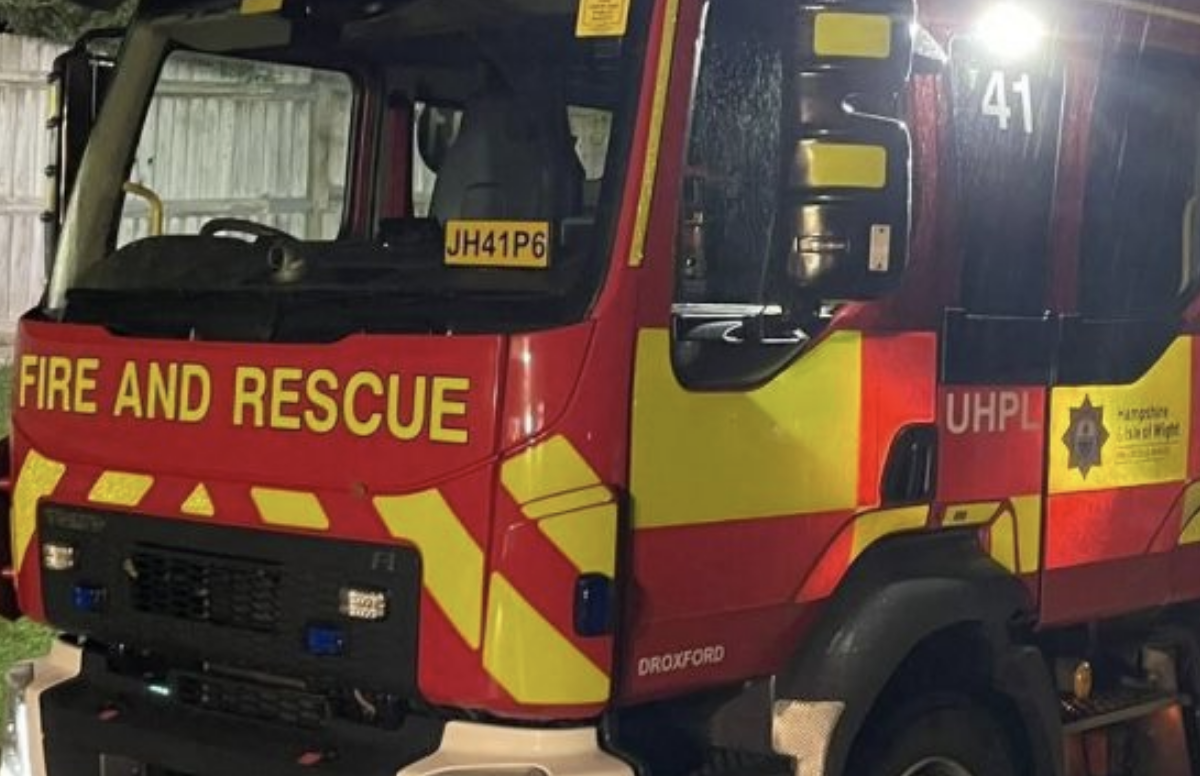
Thousands of pounds of public money were spent developing plans to rebuild Droxford Fire Station before Hampshire and Isle of Wight Fire and Rescue Service said it was not currently in a position to fund the project.
Published spending records show a £3,000 payment for architectural services connected with Droxford in May 2026, while detailed proposals had envisaged a replacement station being operational by summer 2027.
The plans included temporarily relocating the Droxford crew to Bishop’s Waltham while the existing station was demolished and replaced.
However, the fire service is now proposing to pause the rebuild until funding can be identified.
£3,000 architectural services payment identified
The expenditure record, dated May 6, names PWP Architects Limited and describes the payment as “Droxford Architectural Services”, charged to the Station Investment Programme.
The £3,000 payment is one identified cost associated with the proposed redevelopment. The overall amount spent on feasibility, design and other preparatory work has not been established.
Plans developed by the service envisaged creating what was described as the first modular fire station in the UK and its first net-zero fire station.
The modular approach would involve sections of the building being manufactured off-site before being installed at Droxford.
According to the proposals, the approach offered a “more financially viable solution than traditional brick-built buildings”.
A new station was planned for summer 2027
The project timetable set out a series of stages stretching from summer 2026 into 2027.
Preliminary planning, highways and environmental consultations and mechanical and electrical design work were listed for summer 2026.
A full planning application, discussions with the parish council, detailed design work and tendering for a principal contractor were then scheduled for autumn.
Manufacturing of the modular building, relocation of the crew to Bishop’s Waltham, demolition and installation were expected to take place between winter 2026 and spring 2027.
The new station was intended to become operational during summer 2027.
The timetable represented proposed stages of the project and does not establish that each stage was subsequently completed.
Plans highlighted the importance of keeping the Droxford crew
The fire service’s own proposals identified maintaining Droxford’s established crew and emergency response capability as benefits of proceeding with the rebuild.
The document stated that the project: “Maintains the established crew at Droxford, providing operational response to the local area and wider resilience”.
Other anticipated benefits included reducing construction time at the site, limiting disruption to firefighters and neighbouring properties and improving quality control through off-site manufacturing.
The proposals also highlighted reduced material waste, improved energy efficiency, environmental benefits and greater flexibility to accommodate future operational requirements.
The intention was to provide a modern and durable station capable of meeting the service’s longer-term needs.
Fire service says it cannot currently fund rebuild
Despite the work already undertaken, Hampshire and Isle of Wight Fire and Rescue Service has said wider financial pressures mean it is not currently able to fund the rebuild.
Assistant Chief Fire Officer Ben Allen previously said the Fire Authority had agreed in principle that Droxford should be rebuilt if the existing station became unsafe.
He said: “Unfortunately, due to wider financial considerations, the Service is not yet in a position to fund the rebuild.”
The Fire Authority is due to consider the proposed pause on October 8.
The service maintains that Droxford Fire Station remains safe to use and that firefighters continue to respond to incidents as normal.
Structural issues, including problems involving the roof, are being monitored.
If the building were to become unsafe, the service has said temporary arrangements would be introduced rather than the proposed pause automatically resulting in the loss of emergency cover.
Preparatory work could still be used
Hampshire and Isle of Wight Fire and Rescue Service said spending money during the early stages of a capital project was normal and that the work already completed would remain useful if the rebuild eventually proceeds.
A spokesperson said: “As with any capital project, work to explore the redevelopment of Droxford Fire Station has involved a number of preparatory stages. During the early stages of a project, it is normal to incur costs associated with feasibility work, surveys, architectural advice, design development and other professional services.
“This work helps establish the condition of the existing site, understand the options available, develop indicative costs and timescales, and determine whether a proposed scheme is viable.”
The spokesperson added: “As rebuilding Droxford remains our intention, the work and expenditure undertaken to date will continue to inform the project when we are able to progress it.
“In the meantime, the proposal to delay would help us maximise the building’s usable life while we carefully consider when the rebuild could take place.”