British Army Tests Urban Combat Revolution with ‘Urban Phalanx’
The British Army’s Experimentation and Trials Group (ETG) is shaking up future urban warfare with a bold new combat concept. Dubbed Urban Phalanx, this cutting-edge strategy aims to dominate the tight, confusing streets of tomorrow’s cities with small, ultra-effective light infantry teams.
What is Urban Phalanx?
Urban Phalanx focuses on turbocharging small unit tactics for dismounted soldiers fighting in complex urban terrain. Key aims are to improve combat effectiveness by revamping team structures and ramping up lethality. The concept was devised in collaboration with top urban combat experts from the British Army, Royal Marines, and the US Marine Corps’ Warfighting Laboratory.
After rigorous testing and simulations led by the Defence Science and Technology Laboratory (Dstl), results were promising enough to feed directly into Army strategy.
Next Gen Combat Team Takes the Lead
The 2nd Battalion The Yorkshire Regiment has been revamped around Urban Phalanx, now deployed as the Next Generation Combat Team (NGCT). They’ve already put the concept through its paces during Project CONVERGENCE 22 and Exercise CERBERUS 22. Up next: Exercise WESSEX STORM 1/23, where a new company Order of Battle (ORBAT) and beefed-up firepower will be put to the test.
Inside the Urban Phalanx Structure
The NGCT structure centres on two Phalanx Platoons plus a Manoeuvre Support Group. Each Phalanx Platoon boasts:
- Three 10-man sections
- Anti-armour/anti-structure firepower
- A platoon commander, sergeant, and a platoon systems operator managing high-tech gear
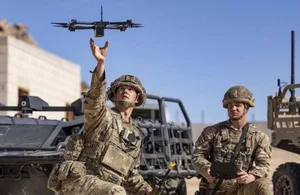
Each 10-man section divides into two 4-person fire teams plus an independent command element. This command duo—consisting of a section commander and a systems operator—handles drones and real-time intelligence, improving situational awareness while lightening the mental strain on commanders.
The systems operator remotely controls small uncrewed air systems (UAS) and updates the Dismounted Situational Awareness (DSA) system, feeding vital data up the chain.
Adding serious punch, each platoon fields a Carl-Gustaf rocket team. This shoulder-launched weapon packs multiple warhead options and doesn’t require specialist operators like the Javelin system, freeing the sections to move faster and fight harder.
Manoeuvre Support Group: Big Guns on Call
The Manoeuvre Support Group packs heavy firepower usually reserved for support companies. It includes:
- Three Javelin detachments for specialist anti-tank fire with longer range than Carl-Gustaf teams
- Two Sensor Decider Effector (SDE) Teams managing patrol command, systems operation, and mortar fire control
- Two 81mm mortar barrels providing integral indirect fire support
The company’s firepower is further boosted by MEP WOLFRAM—a Coyote vehicle armed with modular Brimstone missile launchers—and simulated loitering munitions for platoon and company-level precision strikes.
Expert Insight: Tackling Urban Combat Complexity
“Urban combat breaks down into messy close-quarter mini-battles, often inside the same building,” says Stuart Lyle, Dstl’s urban operations lead and Urban Phalanx designer. “Short ranges and cluttered terrain reduce support from mortars and artillery, making junior leaders and individual soldiers crucial to success.”
“The Phalanx Platoon concept lightens junior commanders’ cognitive load while boosting their ability to neutralise threats quickly.”
Col Toby Till, ETG Lead, adds: “Science has allowed us to expand section sizes for survivability. It also frees section commanders from fire teams, letting them focus on command and digesting info from the systems operator.”
All troops travel in light mobility vehicles designed to keep them agile and fast—no sitting ducks here. The British Army’s Urban Phalanx is shaping up to dominate the battles of tomorrow’s cities.