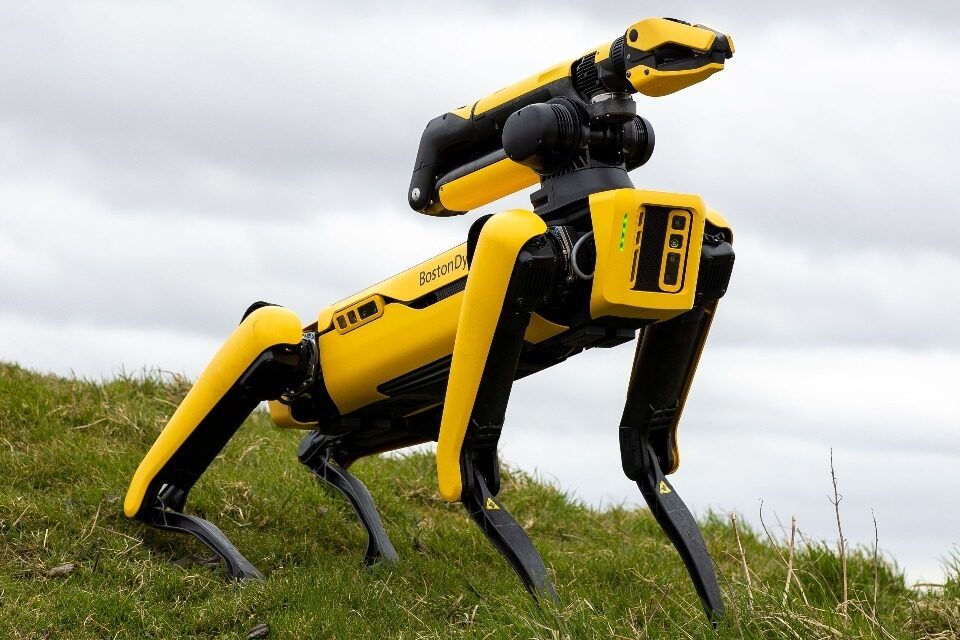
In a groundbreaking event sponsored by the Defence AI Centre (DAIC), forty programmers came together at the Hackathon held from 7 to 9 November to demonstrate how AI-enabled robotic dogs could carry out potentially dangerous tasks that are traditionally undertaken by Army bomb disposal experts.
Organised by the Defence AI Centre in collaboration with the Expeditionary Robotics Centre of Expertise (ERCoE) and Team Defence Information (TDI) at the BattleLab in Dorset, the hackers formed five teams to harness the AI capabilities of the robotic dogs. These advanced machines showcased their ability to climb stairs, navigate obstacles, and traverse rough terrain.
Over the course of the first two days, the teams strategised and fine-tuned their programming techniques. They then tested their robotic dogs in an environment designed to replicate real-life threatening scenarios, providing a rigorous assessment of their capabilities.
On the final day, members of the 29 Explosive Ordnance Disposal (EOD) & Search Group, renowned for their expertise in tactical and technical explosives disposal, witnessed the demonstrations. The teams showcased their achievements, highlighting the potential of AI and robotics in enhancing the safety of bomb disposal operations.
Judged by representatives from 29 EOD&S Group, the DAIC, and DE&S (Defence Equipment and Support), winners were chosen across five award categories: teamwork, collaboration, innovation, practical application, and endeavour and focus.
Cdre Rachel Singleton RN, Head of the DAIC, expressed her excitement at witnessing the collaborative efforts of Defence, industry, and academia. She emphasised the importance of safely and responsibly driving collaborative innovation, particularly in real use cases that aim to protect the well-being of military personnel.
Lt Col Chris Coles of 29 EOD&S Group commended the talent and dedication displayed by the participants, highlighting the potential of bomb disposal tools that minimise the need for human presence in dangerous situations. The event showcased numerous advancements that will undoubtedly contribute to research and development in the EOD&S field.
Wing Commander Paul Austin from the DE&S Future Capabilities Group emphasised the commitment to leveraging technology to provide an edge for the Armed Forces. He praised the participants’ enthusiasm in solving military-focused problems and acknowledged the event as a prime example of successful collaboration within the Defence enterprise.
The Defence AI Centre, established as a result of the 2021 Integrated Review, plays a crucial role in accelerating the adoption of AI within Defence. As a federated organization, it coordinates efforts across Defence Digital, Defence Equipment and Support (DE&S), and Defence Science & Technology Laboratory, ensuring the responsible and effective use of AI technology.