By Chris Hobbs,
Chris Hobbs, a correspondent for Police Oracle, challenges the narrative of Home Secretary Suella Braverman on alleged ‘police bias’, drawing from his experience observing various protests in London since the pandemic.
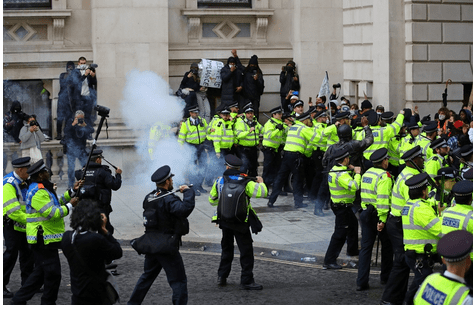
In a recent encounter at Trafalgar Square, Hobbs observed a rally led by supporters of Tommy Robinson, waving the Cross of St. George and Union flags. The rally, initially peaceful, took a violent turn as protestors attacked police officers near Downing Street. This marked Hobbs’ first direct experience with the ‘new’ far-right, different from earlier English Defence League (EDL) demonstrations he had seen on television.
Hobbs notes that the far-right has waned in recent years, but current issues, like the response to asylum seekers and protection statues, have seen minimal support. However, the crisis and the proposed massive march on November 11 have reinvigorated these groups.
Critically, Hobbs points out the Home Secretary’s brief criticism of the far-right in her article for the Times. However, he challenges her view that the police are too harsh on football fans and too lenient on Palestinian protesters. He recalls incidents where police, standing between rival groups at football matches or protests, often face violence, especially from EDL and DFLA (Democratic Football Lads Alliance) factions.
During the Covid pandemic, Hobbs notes the police had to navigate a complex set of new laws and rules while facing aggression, including being spat at and coughed on. He asserts that Braverman’s comments on police handling of anti-lockdown protests rely on distorted social media narratives, ignoring the reality that these protests often attracted violent individuals, including those from the far-right.
In discussing Black Lives Matter (BLM) protests, Hobbs counters Braverman’s suggestion of police softness, highlighting the limited instances of officers ‘taking the knee’ and the violence faced by officers during these protests, particularly the one in Whitehall.
On the threshold for banning protests, Hobbs argues that pro-Palestinian protests, while sometimes controversial, haven’t reached the level of violence that would justify a ban. He fears that banning the upcoming Palestinian protest, as well as a potential far-right counter-protest, could lead to unstructured, chaotic, and dangerous scenarios.
The article concludes with Hobbs expressing significant concern within the police community about the potential for disorder and the perceived betrayal by the Home Secretary through her rhetoric and approach, potentially compromising the safety of officers.