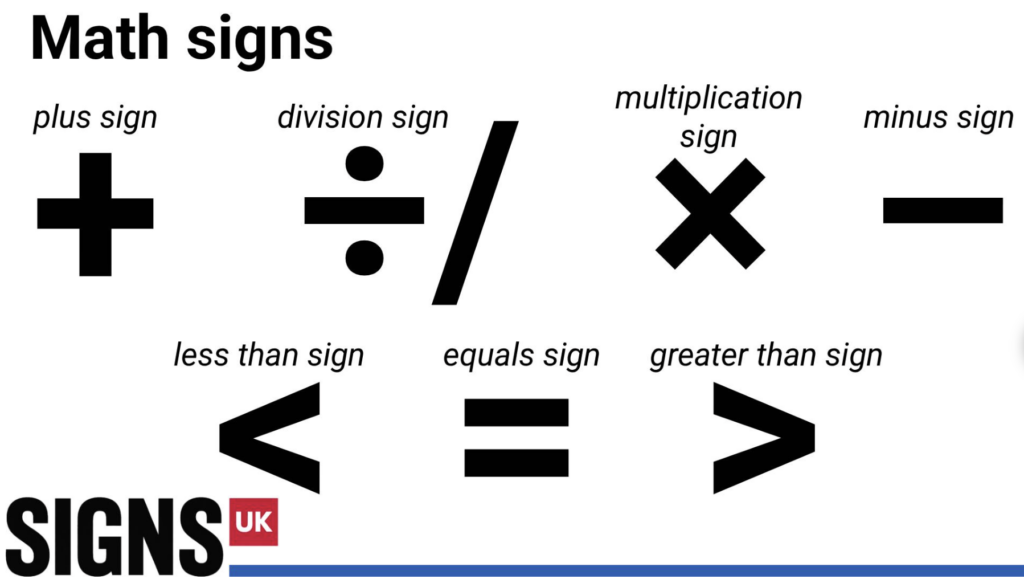
Mathematical symbols and signs are the fundamental language of automotive engineering, design, and maintenance. It is through formulas, graphs, and symbols that engineers describe engine power, acceleration dynamics, road stability, and the operation of electronic systems. Without this universal language, it would be impossible to ensure the accuracy of calculations, the safety, and the reliability of modern vehicles. Mathematical symbols are reflected in some of our most famous symbols and signs.
Arithmetic operations in the vehicle design process
Vehicle design begins with precise numerical calculations, where arithmetic symbols are the basic tool of engineering logic. Addition, subtraction, multiplication, and division are used to determine the geometric parameters of the body, calculate the mass of components, and balance the strength and weight of the structure.
ATTENTION! Even minimal deviations in numbers can affect the aerodynamics, stability, and safety of a car. This must be taken into account when making decisions in numerical format.
During the design phase, engineers work with a large array of data, from metal thickness to axle load distribution. Arithmetic operations allow them to compare the parameters of various components and find optimal engineering solutions. For example, when reducing the weight of a car, it is necessary to compensate for the loss of strength by redistributing materials, which requires precise calculations.
Arithmetic is particularly important when calculating the performance characteristics of a car, where each value must comply with regulations and standards. In this context, mathematical symbols become a universal language of communication between designers, technologists, and testing laboratories.
The most commonly used arithmetic operations in automotive design include:
- Addition (+). For summing the mass of parts, loads, and power indicators.
- Subtraction (−). When determining the difference between parameters, for example, between permissible and actual values.
- Multiplication (×). For calculating areas, volumes, and the force of impact on structural elements.
- Division (÷). For calculating specific indicators, such as fuel consumption or axle load.
Thus, it is safe to say that arithmetic symbols form the basis of engineering calculations, without which it is impossible to create a reliable and safe car. Special attention should be paid to symbols and various calculations should be performed carefully and attentively.
Vehicle dynamics
Vehicle dynamics are directly related to the use of mathematical symbols and signs that describe physical processes. Speed, acceleration, time, mass, and force are expressed through formulas that allow us to predict the behaviour of a vehicle in various road conditions. These calculations form the basis for the development of braking systems, suspension, and stabilisation systems.
FOR YOUR INFORMATION! The equal sign links parameters in mathematical motion models, showing their functional dependence. For example, a change in acceleration directly affects the braking distance, and the mass of the car affects the inertial forces.
Graphs and curves are widely used in engineering practice, where mathematical symbols allow you to visualise the dependence of speed on time or force on acceleration. Such models help engineers assess the stability of a car during manoeuvres, sudden braking, or acceleration. Specialists can easily navigate such graphs and accurately predict subsequent manoeuvres. This is especially important in situations where other calculation options cannot be used due to their inefficiency.
In addition, dynamic calculations are actively used in active safety systems. Electronic assistants analyse mathematical parameters in real time and compare them with reference values. If the actual indicators exceed the permissible limits, the system adjusts the brakes or engine, ensuring control over the movement of the car.
Automotive electronics and control systems
A modern car is a complex electronic system in which mathematical signs and symbols are used to describe, analyse, and control a variety of processes. Electronic control units process numerical data from sensors measuring speed, temperature, pressure, pedal position, and other parameters. This data is expressed through mathematical values that are compared with specified algorithms.
The following options are widely used in automotive electronics to specify and transmit values:
- percentage symbols (%);
- value range symbols;
- equality signs;
- inequality signs.
These options allow the system to determine whether the current parameter complies with acceptable standards. For example, if the engine temperature deviates from the specified range, the electronic unit instantly records the excess or decrease in value and initiates corrective action.
Symbols denoting changes in parameters over time are of particular importance. The Δ (delta) symbol is used to show the difference between current and previous values, allowing the system to track process dynamics. Such mathematical symbols ensure the accuracy of ABS, ESP, adaptive cruise control, and driver assistance systems, where the speed of response directly depends on the correctness of calculations.
Technical documentation, operating instructions, and diagnostic diagrams
Vehicle technical documentation is based on standardised mathematical symbols and conventional signs that ensure a common understanding of information regardless of language and country. Operating instructions, service manuals, and diagnostic diagrams contain numerical parameters, tolerances, and calculated values necessary for the proper maintenance and repair of the vehicle.
REFERENCE! Mathematical symbols allow for the compact and accurate transmission of information about operating modes, maximum loads, and technical requirements. Range, tolerance, and coefficient symbols help specialists quickly navigate the documentation and minimise the risk of errors when performing technical operations.
The most common mathematical symbols in automotive documentation include:
- Tolerance symbol (±). Indicates the permissible deviation of parameters from the nominal value.
- Percentage sign (%). Used to indicate relative values and coefficients.
- Range of values (–). Used to indicate operating temperature, pressure, or voltage ranges.
- Numerical indices and coefficients. Reflect corrections, standards, and technical norms.
Thanks to the use of universal mathematical symbols, technical documentation becomes an accurate communication tool between the manufacturer, engineer, and service specialist, ensuring the safety and reliability of vehicle operation.