The £6.7 Billion Polish Problem
The rhythm of a British sporting weekend feels practically etched in stone. Saturday afternoons belong to the sacred 3:00 PM blackout; Sunday delivers the headline act, while Monday exists purely for tactical autopsies. Broadcasters know this DNA intimately. Sky Sports just dumped £6.7 billion on the table to guarantee that exact same loop survives until 2029. Over two hundred live Premier League broadcasts will soon flood domestic screens every single year. The sheer volume of this inventory creates an undeniable commercial juggernaut. To a casual observer, the English top flight represents flawless, globally exported, and heavily sanitised entertainment.
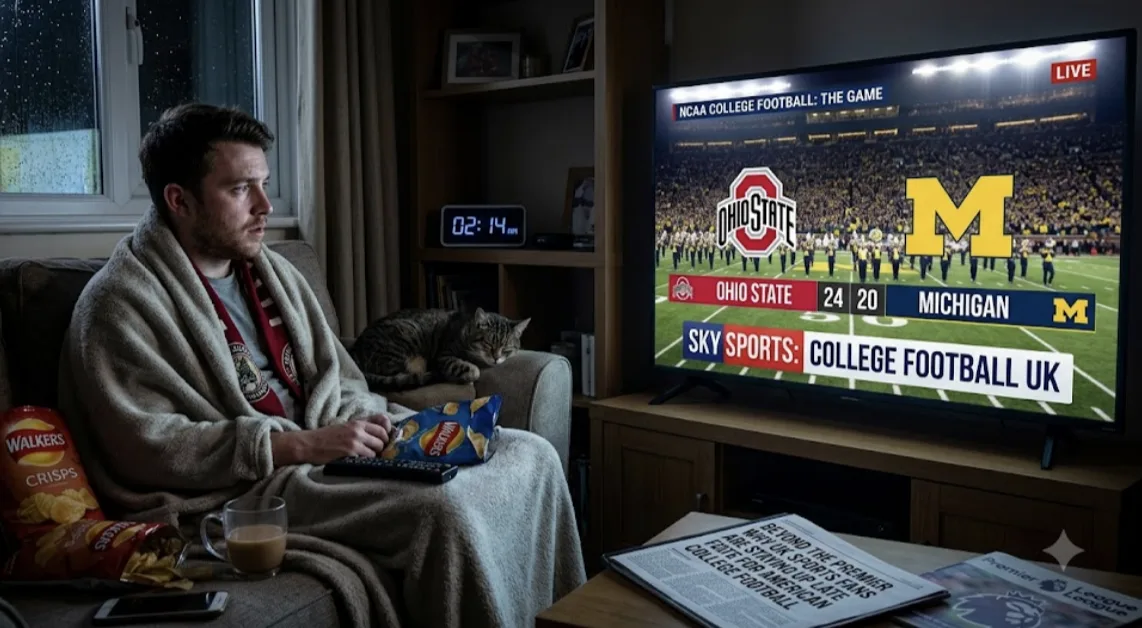
Let’s be real for a second. The very polish that makes the Premier League a global success is driving a dedicated fringe of domestic fans completely mad. You can only watch so many state-backed conglomerates trade billions before the grassroots tribalism feels entirely artificial. Look at the numbers, and you will see executives already noticing the cracks in the armour. Over at TNT Sports, the Saturday lunchtime audience bled out by 17% last season. A specific demographic clearly craves something louder, cheaper, and inherently more chaotic. These viewers are finding that exact cocktail 4,000 miles away, broadcast at two in the morning, under the lights of American college football.
Concrete Leviathans and the “Sicko” Economy
Venture outside the European television bubble, and the physical scale of the American collegiate game immediately breaks the brain. We tend to view stadium scale through a highly localised lens. Anfield holds roughly sixty-one thousand people, which domestic pundits consider an absolute fortress. Meanwhile, a literal university in rural Pennsylvania routinely crams 106,000 lunatics into Beaver Stadium for a standard mid-October kickoff. Eight different college stadiums currently hold over a hundred thousand people; a provincial agricultural college in Texas—like Texas A&M at Kyle Field—easily outdraws Bayern Munich or Real Madrid on a regular Saturday afternoon.
Frankly, money flows through this supposedly amateur tier at a volume that makes the English Championship look like a Sunday league operation. Television networks hand billion-dollar checks to the SEC and Big Ten conferences strictly to secure exclusive broadcast windows. Look closer, and you will realise that US college football odds attract just as much rigorous, high-stakes analysis stateside as the Champions League final does in London. This financial ecosystem operates completely detached from the professional NFL ranks. Despite the historical lack of professional contracts, Thanksgiving weekend viewership numbers absolutely crush top-tier Premier League games in the same market. The annual rivalry game between Ohio State and Michigan alone drew 18 million viewers on American network television last season.
The Midnight Syndicate and the Great Blackout
To access this massive spectacle from the British Isles, fans used to need a degree in digital forensics. For years, BT Sport held the torch by frequently broadcasting two or three ESPN-produced college games simultaneously on a Saturday night. Then, the pipeline snapped violently in the summer of 2023. Disney entirely shut down its international ESPN Player streaming app, and TNT simultaneously opted out of its legacy ESPN agreement. Almost overnight, UK fans were plunged into a bizarre, frustrating media blackout. The only team anyone could legally watch was Notre Dame. Because the independent Irish sold their global broadcast rights directly to NBC, they served as the lone lifeline for a desperate transatlantic audience.
Sky Sports eventually realised a massive, highly engaged demographic was sitting awake at midnight with absolutely nothing to watch. They swooped in late last year, patching the hole with a deal that brings up to three NCAA games a week—plus the post-season College Football Playoff—to British screens. The broadcast windows actually represent a perfect logistical fit. When the 5:30 PM Premier League match wraps up, the American noon kickoffs are just getting started. It stretches the sporting binge straight through to Sunday sunrise. During the blackout, grassroots media filled the cultural gaps. UK-based podcasts like College Football UK and The College Chaps kept the midnight syndicate alive, actively translating the complexities of the American game for a disenfranchised British audience.
Super Leagues, Free Transfers, and Wednesday Night MACtion
Right now, the current era of NCAA football is an absolute geopolitical mess. British fans are eating it up because the structural chaos perfectly mirrors their own domestic sports anxieties. The introduction of Name, Image, and Likeness (NIL) money, alongside the unrestricted Transfer Portal, essentially legalised free-market labour overnight. American traditionalists remain furious about the sudden destruction of amateurism. The British fan, however, grew up in a post-Bosman ruling world of global transfer windows. They simply see a sport finally acting like a real, honest business.
Here is the catch. The ruthless boardroom manoeuvres happening right now feel incredibly close to home. Century-old athletic conferences—like the historic Pac-12—literally disintegrated overnight. Massive collegiate brands deliberately orchestrated that collapse just to hoard a larger slice of network television cash. UK viewers recognised the playbook immediately. They identified the same broadcast-revenue ruthlessness that birthed the despised European Super League concept back in 2021. British fans watch SEC Commissioner Greg Sankey consolidate power with a mixture of morbid fascination and utter dread.
Because British fans lack geographic ties to Alabama or Texas, they remain completely immune to regional bias. Many actively embrace what the internet affectionately calls “Sicko” behaviour. Instead of tracking the polished blue-blood programs, they shun the mainstream to watch midweek games in the freezing rain between obscure Group of 5 teams. There is a gritty, working-class appeal to watching two directional Michigan schools batter each other on a Wednesday night in front of 4,000 people—a phenomenon affectionately known as MACtion. For a long-suffering supporter of the English lower leagues, this chaotic amateur mud-wrestling carries genuine soul. It beats the absolute monotony of watching Manchester City pass another newly promoted squad into submission for the third week in a row.
Ground Zero Under the Wembley Arch
Digital obsession eventually demands a physical footprint. Over in Dublin, the Aer Lingus College Football Classic has already proved that European fans will eagerly cross borders for tailgates, live mascots, and marching bands. For a UK fan, substituting the traditional pre-match pub crawl for an American-style tailgate—complete with elaborate food setups and hours of campus pageantry—represents a fascinating cultural exchange. Commercial organisers are aiming much higher now. The proposed Union Jack Classic is actively attempting to drag a marquee NCAA Division I fixture directly onto the turf at Wembley Stadium. Behind the scenes, podcasters and grassroots organisers are feverishly laying the groundwork to translate American game-day culture for a massive London metropolis.
If a Big 12 or ACC heavyweight matchup actually kicks off under the Wembley arch, it fundamentally rewrites the international hierarchy of American sports. The NFL has always treated London like a highly sanitised, corporate exhibition. Professional American teams operate as franchised assets, ready to relocate across the country if a billionaire owner demands a new taxpayer-funded stadium. European fans despise that lack of loyalty. College football, with its sprawling, unvarnished tribalism, offers something the British market genuinely respects: permanent, geographic stakes. A university cannot simply pack up and move to Las Vegas.
That permanence anchors the entire transatlantic movement. Fans are not just staying up late for the novelty of a marching band anymore. They are burning the midnight oil because the supposedly amateur game across the Atlantic currently possesses more high-stakes soul than the multi-billion-pound leagues operating right in their own backyards.