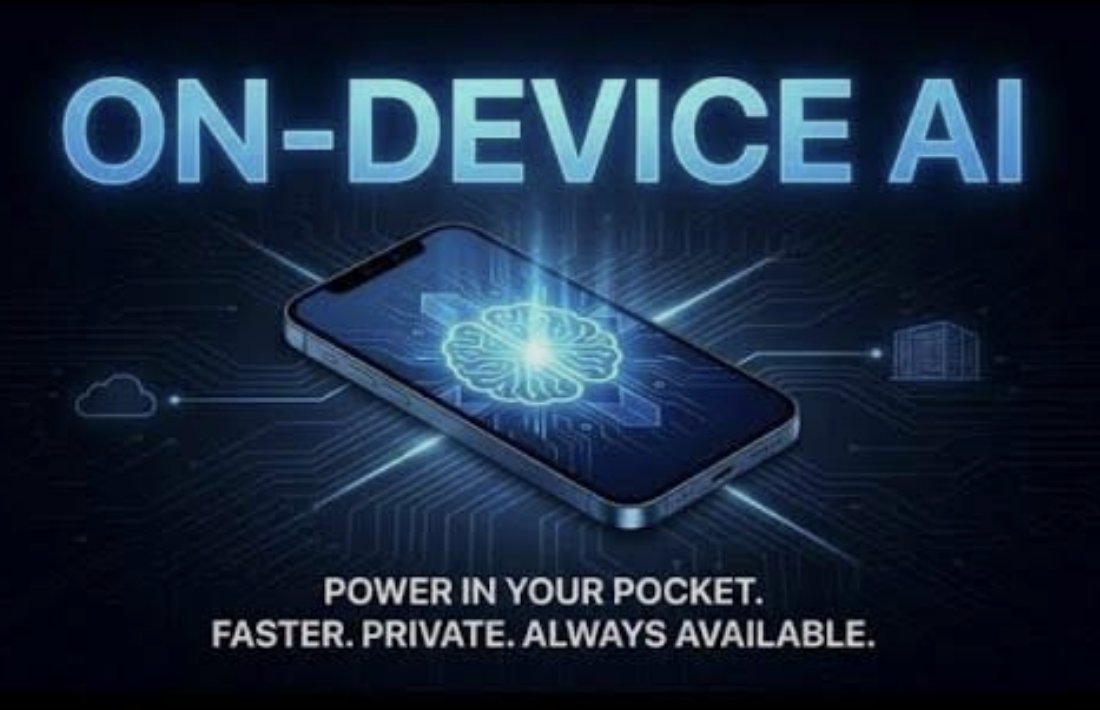
The tech landscape in April 2026 looks nothing like it did two years ago. Back then, asking a smartphone to do something clever meant shipping data off to some distant server farm, waiting a beat, and hoping the connection held up.
Not anymore. The real action has shifted from the cloud to the pocket, the wrist, and even the earbud.
On-device AI is no longer a buzzword; it’s the new baseline for how gadgets operate.
The Neural Processing Unit Has Arrived
This shift comes down to a quiet piece of hardware called the Neural Processing Unit. NPUs used to be a niche feature found only in flagship phones.
Now, they are standard across everything from mid-range smartphones to smartwatches and wireless earbuds. These specialised chips are purpose-built to run AI models locally, crunching numbers without breaking a sweat or draining the battery.
The result is a generation of devices that feel less like tools and more like extensions of the user’s own mind.
How AI Runs the Floor
Across the globe, sophisticated gaming platforms have been quick to see the potential of AI for real-time decision-making. A great example of this transformation is Mafia Casino Login, where machine learning models:
- analyse gameplay patterns to offer personalised
- recommendations flag unusual activity in milliseconds
The same technology that powers instant photo editing on a phone now drives fraud detection and personalised promotions at an online casino.
Many modern online casino platforms use AI to dynamically adjust game lobbies based on individual player behaviour. As a result, they surface titles that match a user’s preferred volatility and theme.
For the most seamless experience, the mobile app integrates these AI models directly into the mobile interface. This enables features like smart game suggestions and real-time session monitoring without cloud-related lag.
It’s a perfect example of how local processing power can transform a complex digital environment.
Speed That Feels Like Instinct
Latency is the enemy of good user experience. Cloud-based AI has to pack data, send it off, wait for a server to process it, and then unpack the result.
That round trip takes anywhere from 100 to 500 milliseconds, sometimes more. On-device AI cuts that down to 10–50 milliseconds.
For gestures, real-time translations, and camera enhancements, that speed changes everything.
- A phone that can remove an unwanted tourist from a photo instantly, without uploading the image anywhere, feels almost magical.
- Smartwatches that can detect an irregular heartbeat pattern and alert the user without pinging a remote server offer genuine peace of mind.
The experience becomes fluid because the intelligence lives right there on the silicon.
Privacy by Default, Not by Policy
The security advantages of local AI are just as compelling as the speed gains. Cloud models require data to leave the device, which means it passes through networks, gets stored on third-party servers, and potentially gets used for model training.
Even with strong privacy policies, that data is no longer exclusively under the user’s control. On-device inference flips that script.
Personal data never leaves the device. A voice command stays on the phone.
A facial recognition check stays on the laptop. A health summary from a smartwatch stays on the wrist.
| Feature | Cloud AI | On-Device AI |
|---|---|---|
| Response Time | 100–500 ms | 10–50 ms |
| Data Location | Sent to remote servers | Stays on the device |
| Internet Needed | Always required | Works completely offline |
| Monthly Cost | High at scale | None after purchase |
| Model Updates | Instant and centralised | Requires system updates |
As regulations tighten and users grow more sceptical of big tech’s data habits, this privacy-first architecture is becoming a major selling point.
The Hybrid Future
Of course, local models have their own limitations. A smartphone NPU, even at 40–50 TOPS, cannot compete with a data centre full of GPUs when it comes to training new models or running massive language simulations.
That is why the smartest implementations use a hybrid approach. Routine, time-sensitive, and privacy-sensitive tasks run on the device.
Heavy lifting — training personalisation models, crunching massive datasets — still sits in the cloud. That part hasn’t moved.
What’s changed is how devices pull their weight. With federated learning, a phone picks up patterns from how it’s used, then sends back stripped-down, anonymous summaries.
No raw data getting shipped around, no drama — just enough to sharpen the central model. It lands in a sweet spot.
Privacy stays intact, performance keeps improving, and the whole thing feels tighter in day-to-day use. By 2026, the shift’s hard to miss: chips have caught up, expectations around data have hardened, and the experience runs smoother across the board.
What used to need a rack of servers now sits in a pocket. Quietly powerful, always on, and no longer a novelty.