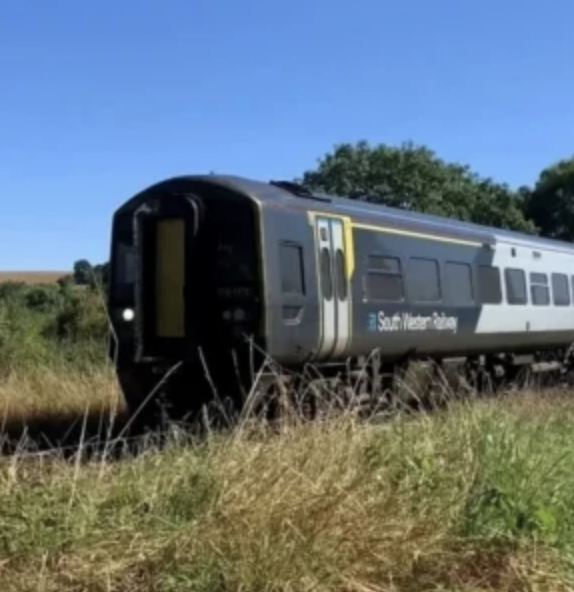
Thousands of holidaymakers travelling to the South West are facing disruption after South Western Railway (SWR) announced reduced services and slower train speeds due to damage caused by Britain’s prolonged heatwave. The operator said exceptionally hot and dry weather has caused soil shrinkage beneath railway embankments, making sections of track less stable and forcing speed restrictions to remain in place.
The changes affect the West of England Line, which connects London with Devon, Dorset, Hampshire, Somerset and Wiltshire, at the height of the summer holiday season.
Reduced Timetable Introduced
Under the temporary timetable:
- Services between London Waterloo and Salisbury will continue every 30 minutes.
- Trains from Salisbury to Yeovil Junction will operate hourly.
- Only every other service will continue to Exeter St Davids.
Passengers travelling to Yeovil Junction could see journeys extended by up to 13 minutes, while services to Exeter may take up to 27 minutes longer.
The changes effectively halve the number of trains operating between Yeovil Junction and Exeter St Davids.
Heat Causing Ground to Shift
SWR said the prolonged dry weather has caused the clay embankments supporting the railway to dry out and shrink, resulting in movement beneath the tracks. The route is particularly vulnerable because much of the line between Tisbury, Wiltshire, and Honiton, Devon, is single track with only six passing loops.
Train drivers have also reported being able to see movement in the rails. Driver Peter Cook said:
“You can tell when rails are moving and you can see that from a long way away.
“At greater speeds it’s more exaggerated.”
Second Year of Disruption
The same section of railway suffered similar disruption between August and November last year.
However, SWR says extensive engineering work carried out since then means the impact on passengers will be significantly less severe this summer. Over the past year engineers have:
- Monitored more than 30 locations between Salisbury and Exeter.
- Laid 5,000 tonnes of new ballast.
- Completed extensive track maintenance.
- Removed more than 200 dead and diseased trees that were drawing moisture from railway embankments.
Railway Boss Apologises
Lawrence Bowman, Managing Director of SWR and Network Rail Wessex, said:
“The record-breaking heat of the last few months has had a significant impact on railways across the UK, and parts of our route are particularly vulnerable.
“Extreme weather events are becoming increasingly common, and this is the second year in a row that prolonged hot, dry weather has affected our network.
“Since last summer’s intervention, we’ve invested in strengthening the route, carried out extensive work to the track and embankments, and developed a plan that customers can rely on.
“We’ve managed to reduce journey times in our amended timetable by around 30 minutes compared to last year, minimising the impact on our customers while also keeping them safe.
“We are sorry for the disruption these changes may cause.
We will restore the regular timetable as soon as conditions allow.”
Climate Change Impact
SWR said current soil moisture deficits are already worse than at the same point last year. The operator is now working alongside the University of Southampton to explore long-term solutions, including changes to embankment vegetation and new track construction methods to improve resilience against increasingly frequent extreme weather.
Passengers travelling on the West of England route are being urged to check journey planners before travelling, as revised timetables are expected to remain in place until ground conditions improve.