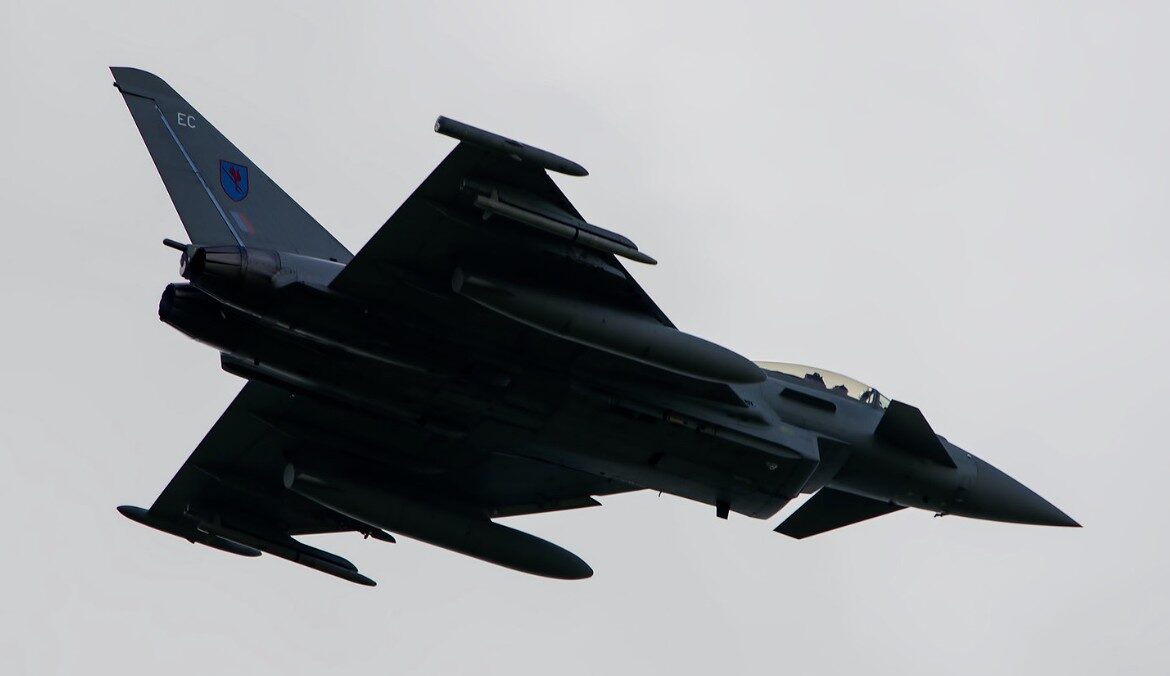
Three RAF Typhoon jets from RAF Lossiemouth were scrambled on Friday afternoon (15 August) after a civilian aircraft approaching the UK’s south-east coast failed to make contact with air traffic control.

The jets’ rapid response is believed to have caused a sonic boom that was heard across parts of Essex and the South East with many resident writing online: “I can confirm you shook our house in Hornchurch It was impressive.”

It intercept a Bombardier Global Express XRS travelling from Nice to London Stansted after the aircraft failed to make contact with air traffic control.
The Eurofighter Typhoon FGR4, launched under the RAF’s Quick Reaction Alert (QRA) protocol, escorted the private jet into Stansted Airport. Communications with the aircraft were later re-established and it landed without incident.
Many people across the South East and East of England reported hearing a loud sonic boom as the Typhoon accelerated to supersonic speed to reach the aircraft.
The RAF source confirmed the interception:
“We can confirm that RAF Quick Reaction Alert Typhoon fighter aircraft from RAF Lossiemouth were launched today to investigate a civilian aircraft which was not in contact with air traffic control.
RAF Typhoons, based at RAF Lossiemouth in Scotland and RAF Coningsby in Lincolnshire, remain on standby 24/7 to intercept any unidentified or unresponsive aircraft approaching UK airspace.
The RAF’s QRA force, based at RAF Lossiemouth in Moray and RAF Coningsby in Lincolnshire, is on constant standby to intercept unidentified civilian or military aircraft approaching UK-controlled airspace.
Once the situation is resolved, Typhoons escort the aircraft away from UK skies before returning to base.