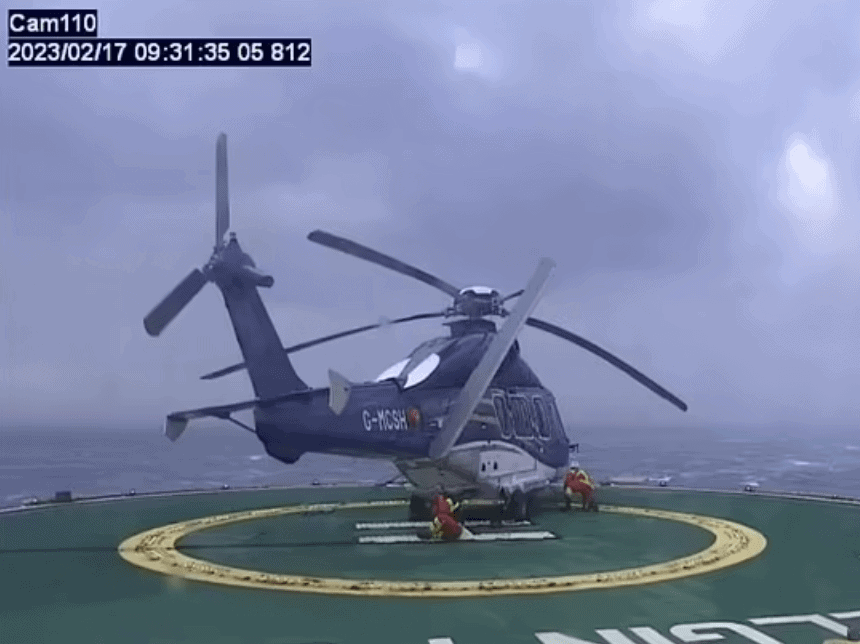
An oil rig worker narrowly escaped serious injury when a helicopter blade snapped and narrowly missed him during high winds on the Elgin Oil Platform, 135 nautical miles east of Aberdeen.
The Airbus H175 helicopter, which had just landed in winds of up to 60mph during Storm Otto on February 17, 2023, suffered a critical mechanical failure, according to a new Air Accidents Investigation Branch (AAIB) report released this week.
Moment of Danger on the Helideck
The incident unfolded after six passengers were dropped off and the aircraft was being prepared for its return journey. A cockpit warning led engineers to advise the crew to shut the helicopter down. However, the rotor brake failed to stop the blades completely due to internal braking system issues, leaving the blades turning slowly.
While the commander and helideck crew attempted to secure the helicopter with tie-down straps, one of the blades suddenly snapped near its root, lifted vertically, and narrowly missed a crew member trying to attach the final strap.
The broken blade continued to rotate briefly before detaching and falling into the sea, with three of the remaining four blades also eventually breaking off.

Damage and Structural Failures
Impact from the broken blades caused significant damage to the aircraft, including:
- Cracks and punctures to the pilot’s left seat window
- Loss of the emergency door handle
- Multiple structural impact marks
The AAIB identified organic material build-up in the braking system as a key factor, which had seized one of the rotor brake pads. Although ground crew noticed issues during towing at Aberdeen airport, these were not passed to engineering staff, and the helicopter was cleared for takeoff.
Helipad Design and Weather Effects
Investigators also blamed design flaws in the helipad structure for exacerbating the situation. Built atop an accommodation block, the pad was exposed to vertical wind acceleration—a “cliff edge” effect—causing the turning blades to “sail” upward under wind force until they fractured.
Although the helideck wind speed was within operational limits, the actual conditions exceeded safe vertical gust tolerances due to structural wind amplification.
AAIB Safety Recommendations
The AAIB has issued six safety recommendations, including:
- Enhanced wind measurement systems on rig helipads
- Revisions to Airbus EC175 (H175) rotor brake maintenance protocols
- Improved communications procedures for reporting technical anomalies prior to departure