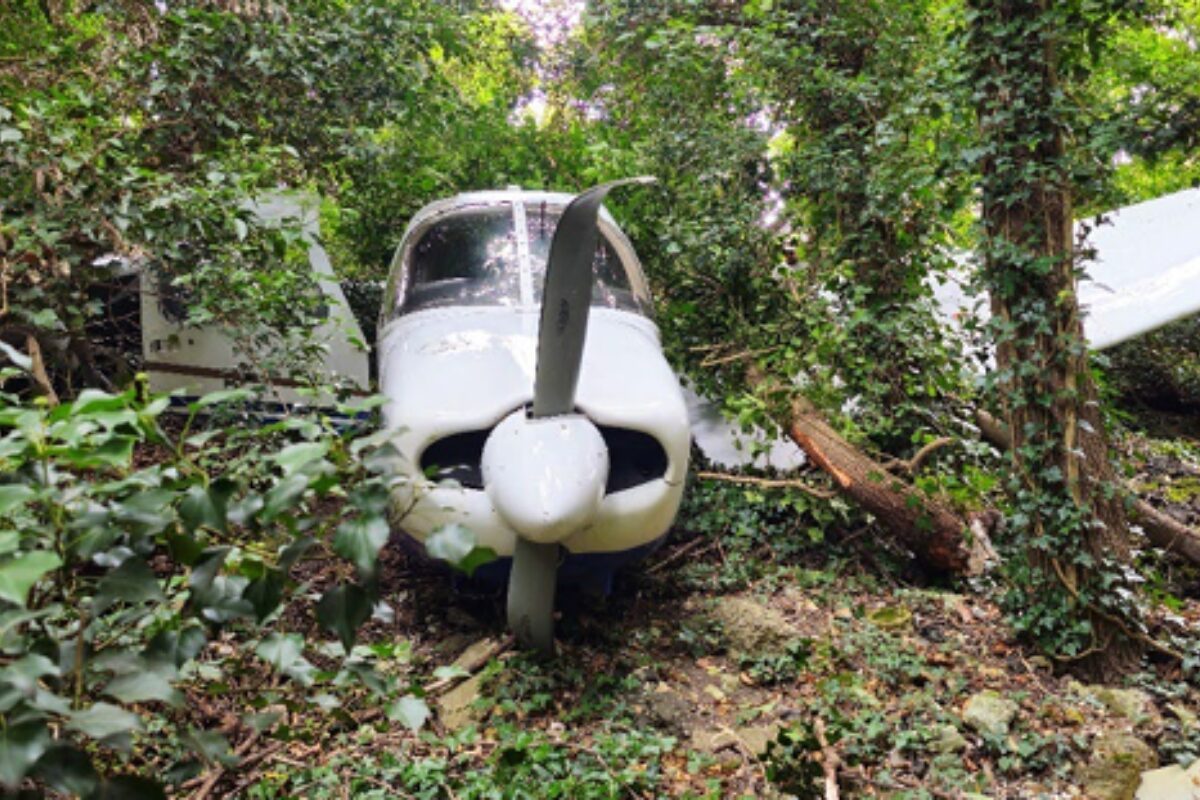
A 79-year-old pilot miraculously walked away uninjured after his light aircraft overran a runway, crossed a road, and crashed into a wooded embankment at Rochester Airport last summer, an official investigation has revealed.
The dramatic incident occurred on 14 August 2024, involving a Piper PA-28-181 aircraft built in 1977, which was later declared damaged beyond economic repair.
The pilot, who had 155 hours of flying experience, was conducting a private solo flight from Lydd Airport to Rochester and was the only person on board.
According to a report published in the March 2025 bulletin by the Air Accidents Investigation Branch (AAIB), the accident was primarily caused by the aircraft landing too fast and too far down the runway after a high-workload go-around and last-minute runway change.
Aircraft Struck Trees After Runway Overrun
The investigation found that the pilot had initially attempted to land on runway 02, but feeling uncomfortable with the approach, he executed a go-around. During the manoeuvre, wind conditions changed and the pilot was advised to land instead on runway 20.
Upon final approach, the aircraft’s ground speed was recorded at 91 knots, significantly higher than the recommended 66 knots. The plane touched down 190 metres from the runway threshold, bounced several times, and despite heavy braking, failed to decelerate effectively on the grass surface.
The pilot, attempting to regain control, pulled back on the yoke just before the end of the runway, causing the aircraft to briefly lift off again. It then cleared the airfield boundary fence and a local road before crashing into a wooded embankment, where its wings were torn off and a fuel leak occurred.
Pilot Escapes Without Injury
Despite the dramatic sequence of events and extensive damage to the aircraft, the pilot emerged unharmed.
In its findings, the AAIB highlighted several contributing factors, including:
- High pilot workload from the go-around and runway change,
- Inadequate speed reduction before landing,
- Reduced braking efficiency on grass runway conditions.
The landing distance available was 830 metres, which would have been sufficient under ideal conditions. However, the excessive speed at touchdown made it unlikely the aircraft could stop in time.
Safety Recommendations Issued
The AAIB report also included safety guidance for general aviation pilots, reminding them to:
- Consider the impact of surface conditions on braking and landing performance,
- Manage cockpit workload effectively,
- Be aware that information from a Flight Information Services Officer (FISO) is advisory, not mandatory, under Aerodrome Flight Information Service (AFIS) operations, as used at Rochester.
The report stated that the pilot could have taken additional time to reduce workload, declined the suggested runway change, or exited the circuit to re-establish a more stable approach.
“Given the touchdown point (190m from the threshold), the aircraft was unlikely to stop within the available runway length,” the report concluded.
“The primary cause of the accident was the aircraft landing too fast and too far along the runway. The pilot recognised post-accident that he had landed faster than normal.”
The full findings are published in AAIB Bulletin 3/2025 and serve as a reminder of the challenges pilots can face in dynamic flight situations — even with relatively routine operations.